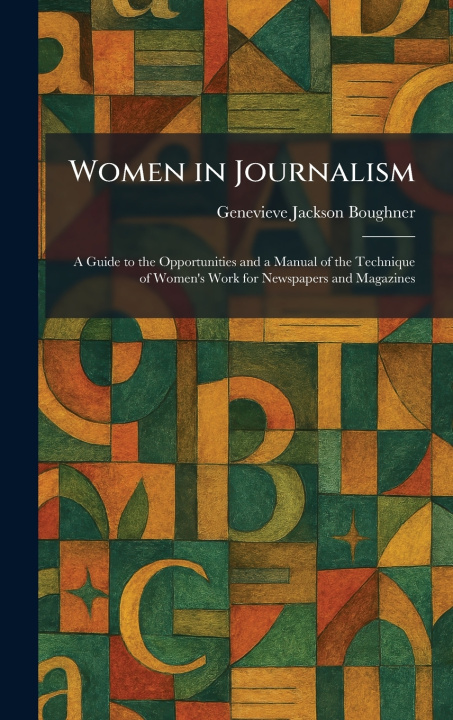
"Women in Journalism" is a pioneering professional manual and career guide that explores the diverse opportunities available to women in the fields of newspaper and magazine publishing. Written as both a practical instructional text and an inspirational roadmap, this work provides detailed insights into the specialized techniques required for success in the media industry during the early twentieth century. Genevieve Jackson Boughner meticulously outlines the various departments where women's contributions were increasingly valued, from society pages and fashion reporting to feature writing and editorial management.
The book serves as a vital historical record of the professionalization of women in communications, offering a manual of technique that addresses the specific requirements of the press. Readers will find comprehensive discussions on news gathering, interview strategies, and the structural nuances of magazine editing. By focusing on the practicalities of the craft, "Women in Journalism" remains an essential resource for those interested in the history of journalism, gender studies, and the evolution of professional media standards. It captures a transformative era when women were actively reshaping the landscape of public discourse through their reporting and editorial prowess.
This work has been selected by scholars as being culturally important, and is part of the knowledge base of civilization as we know it. This work was reproduced from the original artifact, and remains as true to the original work as possible. Therefore, you may see the original copyright references, library stamps (as most of these works have been housed in our most important libraries around the world), and other notations in the work.
This work is in the public domain in the United States of America, and possibly other nations. Within the United States, you may freely copy and distribute this work, as no entity (individual or corporate) has a copyright on the body of the work.
As a reproduction of a historical artifact, this work may contain missing or blurred pages, poor pictures, errant marks, etc. Scholars believe, and we concur, that this work is important enough to be preserved, reproduced, and made generally available to the public. We appreciate your support of the preservation process, and thank you for being an important part of keeping this knowledge alive and relevant.