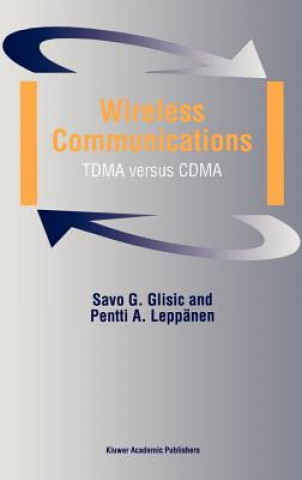
Książka Wireless Communications Savo G. Glisic

Wireless Communications

TDMA versus CDMA

Język: Angielski
Oprawa: Twarda
Wydawca: Springer
Dostępność: Dostępna u dostawcy
Wysyłamy za 10-13 dni
634.56
In Time Division Multiple Access (TDMA), within a given time frame a particular user is allowed to t...


Informacje o książce

Język
Angielski
Oprawa
Książka - Twarda
Data wydania
1997
strony
540
EAN
9780792380054
ISBN
0792380053
Enbook ID
01397370
Wydawca
Waga
2100
Wymiary
156 x 234 x 34

Pełny opis

In Time Division Multiple Access (TDMA), within a given time frame a particular user is allowed to transmit within a given time slot. This technique is used in most of the second-generation digital mobile communication systems. In Europe the system is known as GSM, in USA as DAMPS and in Japan as MPT. In Code Division Multiple Access (CDMA) every user is using a distinct code so that it can occupy the same frequency bandwidth at the same time with other users and still can be separated on the basis of low correlation between the codes. These systems like IS-95 in the USA are also developed and standardized within the second generation of the mobile communication systems. CDMA systems within a cellular network can provide higher capacity and for this reason they become more and more attractive. At this moment it seems that both TDMA and CDMA remain viable candidates for application in future systems. Wireless Communications: TDMA versus CDMA provides enough information for correct understanding of the arguments in favour of one or other multiple access technique. The final decision about which of the two techniques should be employed will depend not only on technical arguments but also on the amount of new investments needed and compatibility with previous systems and their infrastructures. Wireless Communications: TDMA versus CDMA comprises a collection of specially written contributions from the most prominent specialists in wireless communications in the world today and presents the major, up to date, issues in this field. The material is grouped into four chapters: Communication theory, covering coding and modulation, Wireless communications, Antenna & Propagation and Advanced Systems & Technology. The book describes clearly the issues and presents the information in such a way that informed decisions about third generation wireless systems can be taken. It is essential reading for all researchers, engineers and managers working in the field of Wireless Communications.

Możesz być zainteresowany

Chalcogenides

Alexander V. Kolobov
423.49

Joel Embiid

Anthony K. Hewson
128.79

Last Sun

K. D. Edwards
80.21
259.35

Golf Anatomy

Craig Davies
79.82
95.11

Knitwear Design

Carol Brown
151.77

Aurelia

Paperblanks
77.29

Having

Suh Yoon Lee
66.78
38.74
34.65
237.93
50.42
67.46

Gregg Shorthand

John Robert Gregg
48.38

Cosmo Tarot

COSMOPOLITAN
71.06
74.27

Klienci, którzy kupili tę książkę, kupili również

48.57
22.09

Una buena alimentación

Luis María Alonso-Villalobos Martín
117.40
35.04