Książka What Mathematics Do Students Know and How is that Knowledge Changing? PETER KLOOSTERMAN

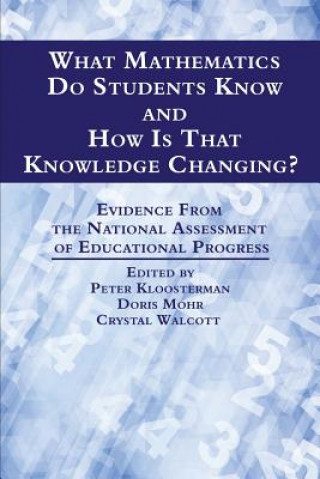
What Mathematics Do Students Know and How is that Knowledge Changing?

Evidence from the National Assessment of Educational Progress

Język: Angielski
Oprawa: Miękka
Dostępność: Dostępna u dostawcy
Wysyłamy za 14-21 dni
283.28
This volume is intended for researchers, curriculum developers, policy makers, and classroom...
Informacje o książce

Język
Angielski
Oprawa
Książka - Miękka
Data wydania
2015
strony
277
EAN
9781681232003
ISBN
9781681232003
Enbook ID
09921444
Waga
553
Wymiary
156 x 235 x 20

Pełny opis

This volume is intended for researchers, curriculum developers, policy makers, and classroom teachers who want comprehensive information on what students at grades 4, 8, and 12 (the grades assessed by NAEP) can and cannot do in mathematics. After two introductory chapters on the design of NAEP, the volume contains a chapter on the challenges in analyzing NAEP data at the item level followed by five chapters that report 2005 through 2013 student performance on specific assessment items. These chapters are organized by content area and then by topic (e.g., understanding of place value, knowledge of transformations, ability to use metric and U.S. systems of measurement) and thus provide baseline data on the proportion of students who are able to complete the mathematics tasks currently used in the upper elementary, middle, and high-school mathematics curriculum. Additional chapters focus on student reasoning, U.S. performance on international assessments, and using construct analysis rather than percent correct on clusters of items to understand student knowledge on specific mathematics topics. Several themes emerge from the volume. One is that while the rate of improvement in mathematics learning in grades 4 and 8 has slowed in recent years, it has slowed more on some topics than others. Another is that relatively minor changes in wording can have significant effects on student performance and thus it is difficult to be specific about what students can do without knowing exactly what questions they were asked. A third theme is that changes in performance over time can sometimes but not always be understood in terms of what students are taught. For example, there were substantial gains on several grade 4 items requiring understanding of fractions and that is probably because the amount of instruction on fractions in grades 3 and 4 has been increasing. In contrast, while relatively few twelfth-grade students have ever been good at factoring trinomials, performance on this skill seems to be decreasing. This suggests that while more students are completing advanced mathematics courses in high school, these courses are not helping in the area of factoring trinomials. Finally, there are limitations to using NAEP as a measure of student performance on the Common Core State Standards. To the extent that NAEP can be used, however, the NAEP data show a substantial gap between expectations and performance.

Możesz być zainteresowany

Familiar Tail

Delia James
37.20

The Duchess

Amanda Foreman
91.69
56.65
629.53

Ireland

Andrew Reid
82.21

Fight

Forrest Jon D Forrest
44.41
362.83
857.45
857.45
68.89

Klienci, którzy kupili tę książkę, kupili również

431.93

Heimat am Meer

Maren Schönle
58.03

Eye for an Eye

Bandula Chandraratna
72.83

Implementing CDISC Using SAS

Holland Chris Holland
242.21

Gengis Kan

Pamela Sargent
36.71
86.16