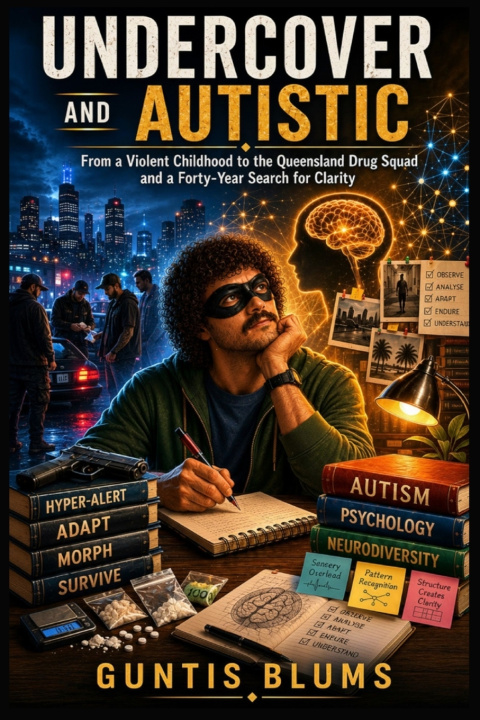
Undercover and Autistic is a memoir about survival, identity, and the long search for an explanation that arrives only after most of a life has already been lived. Beginning in a violent and emotionally barren childhood shaped by family trauma, cultural dislocation, and undiagnosed neurodivergence, the book follows a boy who learns early to watch from the edges, conceal confusion, endure pain quietly, and survive by becoming difficult to read.
Those same habits later find an unlikely home in policing. After joining the Queensland Police in the 1970s, the narrator moves from uniformed patrol into the Drug Squad, where undercover work transforms lifelong masking into a professional asset. His capacity for observation, restraint, pattern recognition, and emotional distance allows him to move through dangerous rooms, drug networks, informants, false identities, and shifting loyalties with unusual effectiveness. Yet the work also exposes him to escalating risk. Operations are compromised, confrontations turn violent, institutional indifference hardens around him, and Philippe Haynes dies during a raid in Kuranda.
The memoir reaches beyond Queensland when the narrator is selected for a Joint Commonwealth-New South Wales Task Force operation targeting international heroin trafficking. His undercover persona carries him from cautious telephone calls in Sydney to a hotel room in Bangkok, where two kilograms of heroin are produced and arrests follow. The operation succeeds, but recognition is muted, the cost is absorbed privately, and the narrator returns to an organisation that often measures visible arrests more readily than concealed risk.
As the years of danger, masking, grief, and institutional disregard accumulate, endurance begins to fail. Workplace pressure, depression, medical retirement, and the loss of the only structure he has known leave him searching for answers outside policing. He turns to psychology, hoping the study of the mind will explain why ordinary life has so often exhausted him while high-risk situations have sometimes felt strangely clearer. But the language available at the time offers only partial answers. Introversion, trauma, vigilance, and depression each describe part of the picture, but none explains the whole.
Decades later, in early 2025, the possibility of autism provides the missing key. Looking back across childhood, language, sensory overwhelm, social exhaustion, peripheral seeing, masking, misread expressions, and the peculiar fit between neurodivergent traits and undercover work, the narrator begins to see a hidden continuity beneath the apparent contradictions of his life. The book does not reduce everything to autism, nor does it offer certainty where uncertainty remains. Instead, it offers something quieter: a humane explanation, hard-won self-understanding, and the relief of no longer being entirely a mystery to oneself.