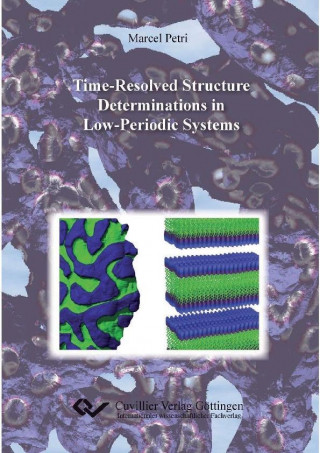
Książka Time-Resolved Structure Determinations in Low-Periodic Systems Marcel Petri

Time-Resolved Structure Determinations in Low-Periodic Systems

Autor: Marcel Petri
Język: Angielski
Oprawa: Miękka
Wydawca: Cuvillier Verlag
Dostępność: Dostępna u dostawcy
Wysyłamy za 8-11 dni
118.79
Molecular self-assembly has given rise to a multitude of low periodic structures and therefore has a...


Informacje o książce

Autor
Język
Angielski
Oprawa
Książka - Miękka
Data wydania
2012
strony
174
EAN
9783954040728
ISBN
3954040727
Enbook ID
12828265
Waga
234
Wymiary
148 x 210 x 9

Pełny opis

Molecular self-assembly has given rise to a multitude of low periodic structures and therefore has attracted considerable interest in science and technology. Knowledge about self-assembly processes is indispensable for soft matter manipulation and the creation of novel nano-structured compounds. During the last decades, nano-technology became an integral part of many technical processes and products encountered in everyday life. It is considered as one of the key technologies [1] to cope with future tasks in health care and environmental protection. In order to image and characterize matter at the nano-scale a multitude of techniques have been developed. Given the fact that conventional far field microscopy is diffraction limited, structures smaller than 200 nm can not be resolved. This restriction can be overcome by using probes with wavelengths which are shorter than visible light. Next to electrons which account for the resolving power of electron microscopes, X-rays and neutrons are employed to gain invaluable insight into the dynamics and composition of matter. In tomographic applications they penetrate the specimen, and magnified sectional images of the object can be created. X-ray diffraction allows to obtain structural information with a resolution better than 2 A provided that the growth of highly purified crystals is possible. Unfortunately, so far many substances have resisted all crystallization attempts or changed their physico-chemical properties as in the case of soft matter. Small angle X-ray scattering (SAXS) is complementary to X-ray diffraction and constitutes one of the most valuable techniques for a characterization of chemical assemblies like micelles, colloids, and gels. Furthermore, it does not require single crystals and allows probing heterogeneous solutions containing a structural ensemble. In this thesis, SAXS has been utilized to pursue three different scientific questions which concern low-periodic structures ranging from microemulsions via proteinaceous hydrogels to ß-barrel proteins.

Możesz być zainteresowany

To Change a Life

Hannah Nelson
112.90

Latin Deli

Judith Ortiz Cofer
165.33
123.70

Sacred Art

Kathleen Hoffmann
57.72

Klienci, którzy kupili tę książkę, kupili również

39.75
64.10

La fe de Oimiuq

CERNUDA RODRIGUEZ
73.72