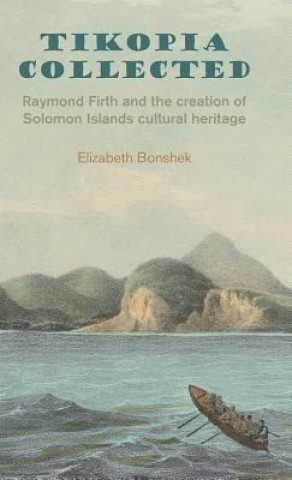
Książka Tikopia Collected: Raymond Firth and the Creation of Solomon Islands Cultural Heritage Elizabeth Bonshek

Tikopia Collected: Raymond Firth and the Creation of Solomon Islands Cultural Heritage

Język: Angielski
Oprawa: Twarda
Dostępność: Dostępna u dostawcy
Wysyłamy za 10-18 dni
323.87
During 1928-9 the renowned anthropologist Raymond Firth visited Tikopia, a small island in the east...


Informacje o książce

Język
Angielski
Oprawa
Książka - Twarda
Data wydania
2017
strony
228
EAN
9781907774393
ISBN
1907774394
Enbook ID
16050686
Waga
518
Wymiary
223 x 148 x 23

Pełny opis

During 1928-9 the renowned anthropologist Raymond Firth visited Tikopia, a small island in the east of Solomon Islands, for the first time. This book takes the collection he made as its subject, and explores how through its acquisition, Firth ceased to be a stranger and became a respected figure incorporated into Tikopia society. The objects were originally viewed by Firth as data in a scientific record of a culture, and evidence challenging the belief that complex economic transactions could only take place in a recognizable market economy. Elizabeth Bonshek, however, revisits the collection's documentation and the ethnography of Tikopia with a different intent in mind: to highlight the social relations the collecting process illuminates and to acknowledge Tikopia voices, past and present. She argues that Firth downplayed the impact of contact with outsiders - whalers, traders and missionaries calling for the abandonment of the Work of the Gods - yet this context is vital for understanding why local people actively contributed to his collecting and research. She follows the life of the collection after leaving the island in institutions that attributed different meanings to its significance, in a failed repatriation request and in a new role in the transmission of 'cultural heritage' along with Firth's writings. She concludes that Firth's exchanges of objects with other high-ranking men were culturally appropriate to the social values dominant in that time and place. Indeed, she suggests that while Firth was acquiring Tikopia artefacts, the Tikopia were perhaps acquiring him. On what ethical and economic terms does an anthropologist acquire other people's things? Collecting Tikopia deftly applies the insights of contemporary material culture studies to a historically important case. Bonshek coaxes ethnographic documents and museum artefacts to reveal how objects both materialize cultural identities over time and mediate social relations across worlds of difference. Professor Robert Foster, University of Rochester, President of the Society for Cultural Anthropology. Richly supported by documentation this skilful and insightful analysis reveals the complexity of cross-cultural interactions and highlights important concerns for the interpretation and management of cultural heritage in museum 'treasure places' worldwide. Dr Robin Torrence, Senior Principal Research Scientist, Anthropology Research, Australian Museum.

Możesz być zainteresowany

38.35

Neverending Story

Michael Ende
65.78
73.79
65.10

First Class Murder

Robin Stevens
31.72
255.44

GLENDIVE

Dr R. Michael Booker Jr
101.41
57.58

Frederick the Great

Nancy Mitford
44.60

Metz 1944

Steven Zaloga
81.79
37.86
147.00

Big Book of Women's Trivia

Alicia (Alicia Alvrez) Alvrez
43.82
70.37

Klienci, którzy kupili tę książkę, kupili również

4.09

Capitanes valientes

Rudyard Kipling
49.87

Moriz von Craun

Ulrich Pretzel
131.67

Finlyandiya 1809-1944

Andrej Kashkarov
114.98
83.16
349.64

Slow Food Devrimi

Carlo Petrini
62.56