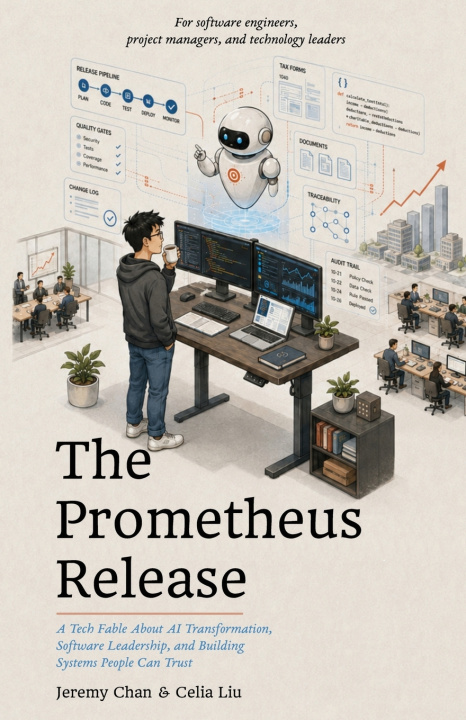
What happens when AI makes a company faster than its judgement?
Fiscari has the story every investor wants to hear. A traditional tax software company is reinventing its legacy product as Prometheus: an AI-driven, conversational platform for professional tax work. Coding agents are everywhere. Dashboards turn green. Executives see the perfect launch narrative taking shape.
At first, everything looks like progress.
Then the deadline closes in.
The team discovers that speed is not the same as trust. AI can accelerate production while hiding errors, confusing accountability, and making ambiguous work look finished. In tax software, a confident answer is not enough. A generated summary can become authority. A dashboard can make the wrong work look right. A demo can become a liability before anyone notices.
The Prometheus Release is a fast-paced tech fable about AI transformation, software leadership, and building systems people can trust. It is a story for anyone trying to move faster with AI without losing the judgement, evidence, and accountability that serious software requires.
Through the pressure of one high-stakes launch, the story explores:
This is a book about AI transformation at the point where the slide deck meets production reality. It is not about whether AI will change software work. It is about what has to remain reviewable, owned, and human when it does.
For anyone building, managing, funding, or depending on AI-driven software, The Prometheus Release asks the question that matters most: when the system says it is ready, who knows whether to believe it?