Technology is advancing at an extraordinary pace. The question is whether we are advancing with it.
Artificial intelligence is transforming knowledge work. Automation is reshaping industries. Digital systems increasingly influence how we communicate, learn, make decisions, and organise our lives. Yet despite these remarkable advances, many of the challenges facing organisations today are not technical. They are profoundly human.
Why do capable organisations struggle to adapt?
Why do governance frameworks create compliance rather than clarity?
Why does knowledge disappear faster than it can be replaced?
Why do trust, judgement, resilience, and leadership become more important as technology becomes more capable?
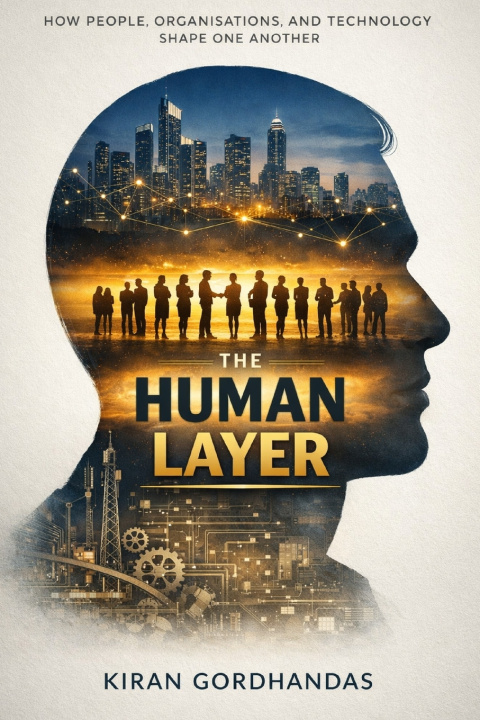
The Human Layer explores these questions through a collection of interconnected essays examining the relationship between people, organisations, and technology. Rather than focusing solely on innovation, it looks beneath the surface to understand the human systems that ultimately determine whether innovation succeeds or fails.
Drawing on themes including organisational behaviour, leadership, artificial intelligence, telecommunications, capability development, resilience, governance, digital transformation, and systems thinking, the book argues that technology rarely determines outcomes on its own. Progress depends upon the quality of the organisations that build it, the leaders who guide it, and the people who use it.
Whether examining the hidden costs of automation, the future of work, the resilience of critical infrastructure, the importance of mentoring and institutional knowledge, or the ethical challenges created by increasingly intelligent systems, each chapter returns to the same central idea:
The greatest challenge of technological change is no longer technological; It is human.
Written for leaders, engineers, project professionals, technologists, policymakers, and anyone interested in how technology shapes society, The Human Layer offers a thoughtful and practical perspective on one of the defining questions of our time.
The future will be shaped by technology. Whether it benefits society will depend on the people who shape the technology.