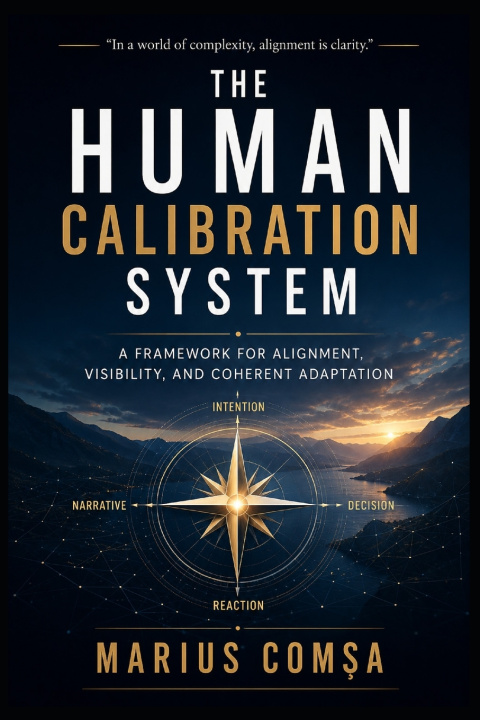
The Human Calibration System
Why do intelligent people make self-defeating decisions?
Why do organizations drift away from their purpose?
Why do institutions lose trust?
Why do societies become fragmented despite having more information than ever before?
The answer may not be a lack of knowledge.
It may be a lack of calibration.
In The Human Calibration System, author Marius Comșa introduces an original framework for understanding how individuals, relationships, organizations, and societies maintain-or lose-coherence over time.
Built around four fundamental dimensions:
Intention
Decision
Reaction
Narrative
the Human Calibration System reveals how drift emerges, why visibility matters, and how alignment can be restored.
Combining systems thinking, psychology, organizational theory, leadership, decision science, and practical tools, this book provides both a conceptual model and a real-world methodology for navigating complexity.
Inside you will discover:
The mechanics of human drift
The Four Axes of Alignment
The Daily Calibration Protocol
The Alignment Audit
The Personal Calibration Matrix
Recalibration Strategies
Relationship and Organizational Calibration
The Human Calibration Score (HCS Index)
A vision for the future of human alignment in the age of AI
Whether you are a leader, entrepreneur, coach, researcher, educator, or lifelong learner, this book offers a powerful framework for seeing more clearly, deciding more coherently, and adapting more effectively.
Because alignment is not a destination.
It is a practice.