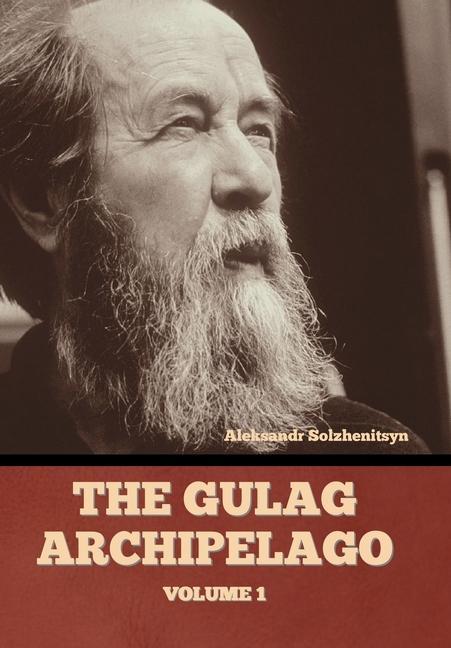
The Gulag Archipelago: An Experiment in Literary Investigation (Russian: Архипелаг ГУЛАГ, Arkhipelag GULAG) Note 1 is a three-volume non-fiction text written between 1958 and 1968 by Russian writer and Soviet dissident Aleksandr Solzhenitsyn. It was first published in 1973, and translated into English and French the following year. It covers life in what is often known as the Gulag, the Soviet forced labour camp system, through a narrative constructed from various sources including reports, interviews, statements, diaries, legal documents, and Solzhenitsyn's own experience as a Gulag prisoner.
Following its publication, the book initially circulated in samizdat underground publication in the Soviet Union until its appearance in the literary journal Novy Mir in 1989, in which a third of the work was published in three issues. Since the dissolution of the Soviet Union, The Gulag Archipelago has been officially published in Russia.
Historian and archival researcher Stephen G. Wheatcroft described the book as "a fine literary masterpiece, a sharp political indictment against the Soviet regime, and has had tremendous importance in raising the issue of Soviet repression in the Russian consciousness." Wheatcroft wrote that the book was essentially a "literary and political work", and "never claimed to place the camps in a historical or social-scientific quantitative perspective" but that in the case of qualitative estimates, Solzhenitsyn gave his high estimate as he wanted to challenge the Soviet authorities to show that "the scale of the camps was less than this."Note 3 UCLA historian J. Arch Getty wrote of Solzhenitsyn's methodology that "such documentation is methodically unacceptable in other fields of history." Gabor Rittersporn shared Getty's criticism, saying that "he is inclined to give priority to vague reminiscences and hearsay ... [and] inevitably [leads] towards selective bias."
In an interview with the German weekly newspaper Die Zeit, British historian Orlando Figes stated that many Gulag inmates he interviewed for his research identified so strongly with the book's contents that they became unable to distinguish between their own experiences and what they read: "The Gulag Archipelago spoke for a whole nation and was the voice of all those who suffered." Soviet dissident and historian Roy Medvedev referred to the book as "extremely contradictory"; in a review for the book, Medvedev described it as without parallel for its impact, saying: "I believe there are few who will get up from their desks after reading this book the same as when they opened its first page. In this regard I have nothing with which to compare Solzhenitsyn's book either in Russian or world literature." (wikipedia.org)