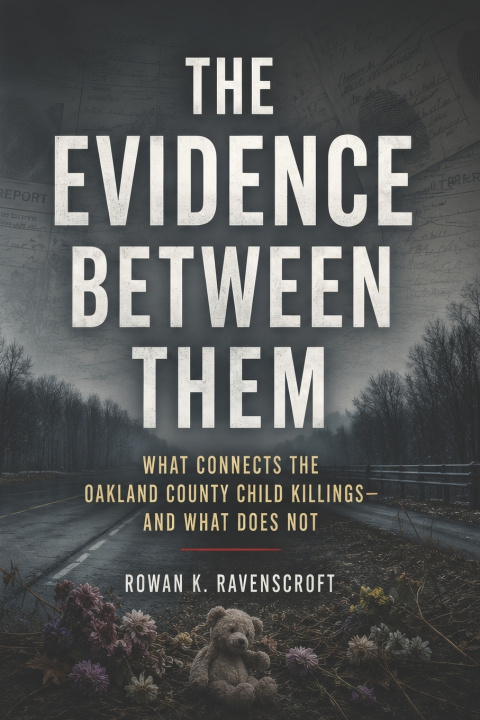
Four deaths became one case. But does the surviving evidence support one offender?
The Evidence Between Them re-examines the Oakland County Child Killings of 1976-1977 through the public record, asking a question the case's familiar name can obscure: which connections among Mark Stebbins, Jill Robinson, Kristine Mihelich, and Timothy King are strongly supported-and which depend on assumption, repetition, or incomplete evidence?
This historical true crime investigation reconstructs each disappearance and recovery before comparing the timelines side by side. It examines last sightings, missing intervals, transport and body-placement patterns, medical findings, witness accounts, vehicle reports, composite imagery, trace evidence, and the investigative decisions that shaped how four separate cases came to be treated as one.
The book gives particular attention to the forensic evidence that has carried the case across five decades. Hair comparisons, mitochondrial DNA results, fibres, preserved exhibits, evidence provenance, and the limits of 1970s collection methods are considered carefully. A reported association may identify a meaningful link without identifying a perpetrator; a similarity may support a theory without proving a shared source. Those distinctions remain central throughout.
The investigation itself is also placed under examination. The original multi-agency task force, major suspect leads, disputed records, family efforts to obtain information, interagency disagreement, lost or compromised opportunities, and later cold case review all form part of the story. Newer tools-including advanced DNA testing, forensic genetic genealogy, and computer-assisted record analysis-are assessed for what they may clarify, as well as what damaged, consumed, incomplete, or poorly documented evidence may no longer be able to answer.
Rather than manufacturing a solution or promoting a preferred suspect, The Evidence Between Them tests competing explanations against the same standard. Could one offender account for all four cases? Could a principal offender have received help? Is the recognized series larger than the evidence can safely support? What additional result would be necessary to move any theory from plausible to established?
Written in a restrained, evidence-aware style, this book separates confirmed facts, official findings, witness testimony, allegation, inference, and speculation. The children and their families remain central, while graphic detail and false certainty do not.
For readers interested in Michigan true crime, unsolved murder investigations, forensic evidence, historical cold cases, and the difficult boundary between connection and proof, this account offers a careful path through what is known, what is disputed, and what may still be possible to establish.