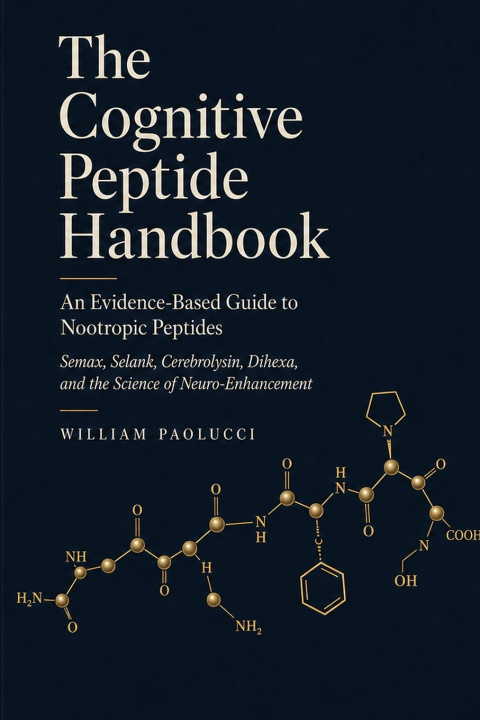
The science of brain peptides, graded honestly.
One peptide is sold as a focus switch. Another is said to spur the growth of new brain cells. A third has a cult following among biohackers and athletes a continent away. Search any of them and you drown in vendor copy, forum lore, and confident strangers, with almost nothing that weighs what the evidence actually shows.
The Cognitive Peptide Handbook is a comprehensive, evidence-graded reference to the whole class of nootropic and neuro-enhancing peptides. It does what vendor pages and forum threads rarely do: it grades the science honestly, compound by compound.
Fifteen compounds, each its own chapter: Semax, Selank, Cerebrolysin, Noopept, Dihexa, Cortexin, Epitalon, Humanin, and more. For each one: what it is, how it acts on the brain, what human and animal studies have genuinely found, and exactly where it lands on a transparent A-to-D evidence scale. Nothing is oversold. Where the data is thin, the book says so. Where a celebrated finding was later retracted, the book tells you that too.
What makes it different:
- Maps the entire class, not one trendy molecule
- A clear Tier A to Tier D evidence grade on every compound
- Draws a hard line between the four things the hype blurs together: the biology, the clinical trials, the community reputation, and the legal status
- More than 400 cited sources, in a full Works Cited you can check yourself
Who it is for: the curious reader who wants the real picture instead of the sales pitch, the researcher or clinician orienting to an unfamiliar field, and anyone who has read the forums and wants to know which parts to believe.
This is a reference, not a protocol. It explains the science. It does not tell you what to take.