What happens when the vote count becomes too technical for the public to trust?
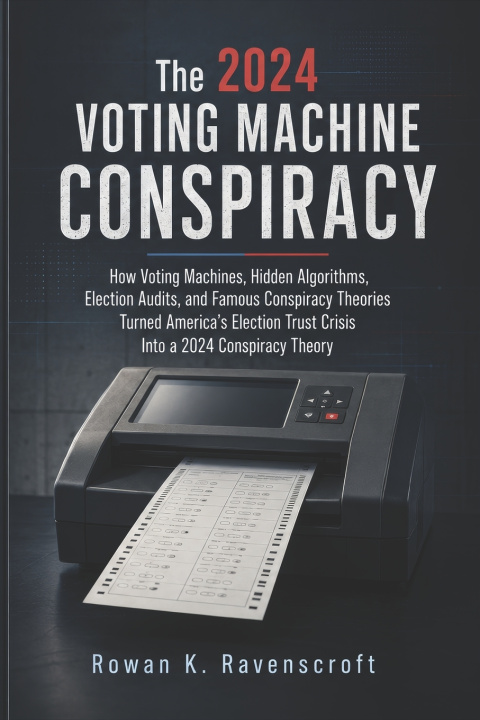
The 2024 Voting Machine Conspiracy is a document-first nonfiction investigation into voting machines, election audits, hidden-code claims, public suspicion, and the trust crisis that turned America's 2024 election into another battlefield of competing narratives.
This book begins with a crucial distinction: a vulnerability is not the same thing as exploitation. A system weakness may deserve serious scrutiny, reform, and public explanation. But proving that a weakness changed votes requires something much stronger: local records, audit failures, chain-of-custody problems, altered outputs, credible evidence, and a documented path from risk to result. That line between concern and accusation is where the story begins.
Across thirty-two chapters and appendix dockets, the book examines the official surface of the 2024 result, federal election-security reassurance, the role of private voting-technology vendors, Dominion-related public distrust, ImageCast X vulnerability concerns, ballot-marking devices, barcode and QR-code anxiety, paper-record debates, post-election audits, courtroom consequences, fake visuals, viral clips, Starlink vote-rigging claims, and the way small fragments can become persuasive "proof objects" before they are verified.
This is not a book built to prove every suspicion true. It is also not a book built to dismiss every skeptic. It is a careful investigation of how modern election conspiracy theories form when legitimate security questions, technical complexity, institutional distance, partisan disappointment, and online amplification collide.
The result is a clear, readable study of election trust in a technical democracy. It follows what the official record can support, what the public narrative claimed, where uncertainty remained, and why many voters found machine-rigging stories emotionally plausible even when the available record did not prove vote manipulation.
The stronger question is not only whether machines changed votes.
It is why so many people believed they could.
The book's structure includes two Chronology Dockets and an Evidence Docket designed to separate verified baseline events from narrative spread. The Evidence Docket grades subjects by evidentiary strength, source basis, limitations, and what the record does not prove. That structure makes the book especially useful for readers interested in election integrity, voting technology, disinformation, conspiracy theories, public trust, and the fragile boundary between documented concern and unsupported certainty.
Readers will find a balanced treatment of voting-machine distrust, election audit debates, voting-system vulnerability concerns, private election vendors, court-tested claims, paper ballot verification, and the political afterlife of machine-rigging narratives. The book keeps one principle in view throughout: democratic trust cannot survive on authority alone when the process feels hidden, but suspicion cannot replace evidence.
The machine story was never only about machines.
Read The 2024 Voting Machine Conspiracy and follow the record where rumor could not.