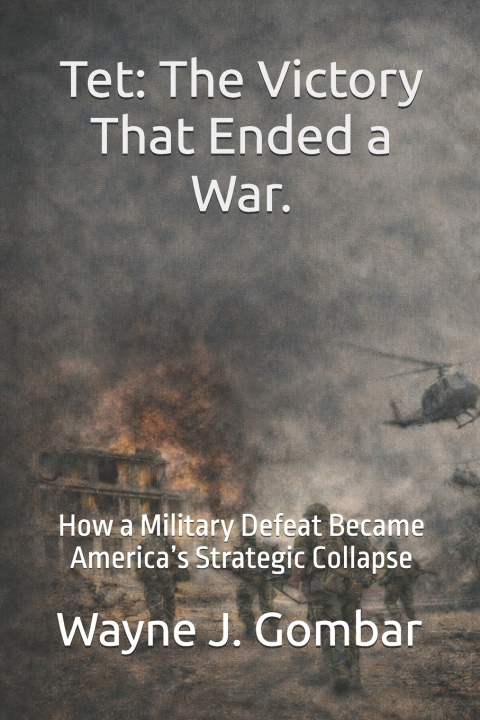
The Tet Offensive of 1968 has long been described as a paradox: a devastating military failure for North Vietnam that nonetheless shattered American confidence and altered the course of the Vietnam War. This book argues that Tet was neither paradox nor anomaly-but revelation.
Drawing on military history, political analysis, media studies, and civilian-centered scholarship, this work reframes Tet as the moment when the limits of power became undeniable. American and South Vietnamese forces defeated the offensive on the battlefield. Yet Tet exposed a fatal misalignment between military success and political legitimacy-between what could be done and what could be credibly promised.
Rather than treating Tet as a media distortion or inevitable quagmire, this study situates it within the broader dynamics of democratic warfare: the fragility of public consent, the centrality of civilian experience, and the decisive role of perception in modern conflict. It integrates the perspectives of American soldiers, South Vietnamese defenders, civilians caught between armies, and policymakers trapped by escalation logic.
Moving beyond Vietnam, the book traces Tet's echoes through later conflicts in Iraq and Afghanistan, demonstrating how its lessons continue to shape wars fought among populations and under constant observation. Tactical dominance, it shows, cannot compensate for eroded legitimacy.
This is not a book about defeat. It is a book about limits-of power, persuasion, and endurance-and about the discipline required to recognize them before belief collapses.
Tet did not end the Vietnam War.
It ended the war Americans believed they were fighting.
Author Bio
Wayne J. Gombar is a historian, analyst, and senior executive whose work focuses on modern conflict, legitimacy, and the intersection of military power and political authority. His research examines how wars are won and lost not solely on the battlefield, but in the contested domains of public belief, civilian experience, and institutional decision-making.
With a background spanning military service, critical-infrastructure leadership, and advanced academic study, Gombar brings a multidisciplinary perspective to the study of war and statecraft. His work integrates military history, political analysis, media dynamics, and civilian-centered approaches to conflict, with particular emphasis on Cold War-era interventions and their modern echoes.
In this volume, Gombar approaches the Tet Offensive not as a tactical episode or media anomaly, but as a revelatory event that exposed enduring vulnerabilities in democratic warfare. His analysis situates Vietnam within a broader continuum of conflicts in which legitimacy, perception, and civilian harm proved decisive.
Gombar's writing is characterized by institutional rigor, narrative discipline, and resistance to polemic. He emphasizes responsibility over blame, explanation over ideology, and synthesis over simplification. This approach reflects his broader commitment to historical honesty and policy relevance.
He lives in the United States and continues to research, write, and advise on issues of conflict, governance, and strategic legitimacy.