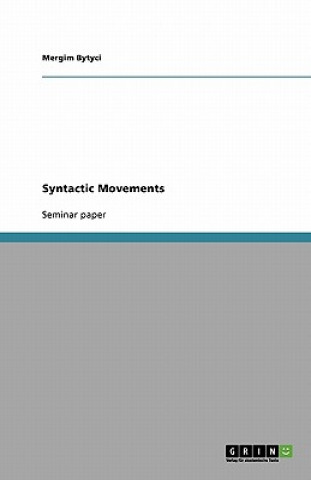
Książka Syntactic Movements Mergim Bytyci

Syntactic Movements

Autor: Mergim Bytyci
Język: Angielski
Oprawa: Miękka
Wydawca: Grin Verlag
Dostępność: Dostępna u dostawcy
Wysyłamy za 5-8 dni
66.79
Seminar paper from the year 2008 in the subject English Language and Literature Studies - Linguistic...


Informacje o książce

Język
Angielski
Oprawa
Książka - Miękka
Data wydania
2009
strony
28
EAN
9783640420247
ISBN
3640420241
Enbook ID
01624683
Wydawca
Waga
45
Wymiary
140 x 216 x 2

Pełny opis

Seminar paper from the year 2008 in the subject English Language and Literature Studies - Linguistics, grade: 2.0, Technical University of Braunschweig, language: English, abstract: 1. IntroductionIn the course of this term paper I will analyze three kinds of syntactic movements, which will be the Head Movement, Argument Movement and the Wh-Movement. Initially I will defer to basic knowledge such as Feature Checking, Merge and C-Command since these operations are the basis of syntactic comprehension.After a short introduction I will briefly discuss and explain the Head Movement and the Argument Movement with the help of examples before I focus on the latter, namely the Wh-Movement. This syntactic operation will be the core of this paper. I will try to analyze the latest concepts and approaches to this issue and try to illustrate the way Wh-Movement takes place by several examples. I decided to concentrate on Adger s and Radford s points of view on this topic since they rate among the most accepted syntacticians worldwide. Despite this I will parse their statements very closely and try to find potential differences or grievances.An interesting question will be whether all operations can be explained in a plausible way or if there are arbitrary assumptions without any evidence. 2. Feature CheckingSyntacticians assume that every word of a sentence bears certain features. These features are called categorial-selectional (or c-selectional) features and can be either interpretable or uninterpretable. A noun, for example, bears an interpretable feature [N], a verb [V], an adverbial [Adv] and a preposition the feature [P].A verb cannot stand alone in a sentence but it needs the existence of a subject. In order to explain this phenomenon linguists came to the assumption that a verb has to bear uninterpretable features as well. Since a verb needs the presence of a subject, which usually is a DP, it is assumed that the verb bears next to the interpretable feature [V] the uninterpretable feature [N] (abbreviated [uN]). 2.1 MergeThis uninterpretable feature has to be checked and deleted in order to form a grammatically correct sentence. This happens via the operation of Merge. Merge can only

Możesz być zainteresowany

Wabi Sabi

Beth Kempton
74.70
1 451.58
74.70

Survivor's Guilt

Karle Johnson
25.77
75.88

In This Moment

Karen Kingsbury
62.01

Southern California

National Geographic Maps
33.78

Cost of Living

Deborah Levy
43.16
465.17

Furyborn

Claire Legrand
35.64

Europeans

Orlando Figes
74.80

Plantopedia

Sophia Kaplan
155.77

Book of Healing

Najwa Zebian
65.13

Klienci, którzy kupili tę książkę, kupili również

Due case

Aldo Germani
73.14

106 PALABRAS

VIDAL GUARDIOLA
75.97

Le bull terrier

DEUTSCH JULIE
88.77

Bezwstydna cnota

Roberts Nora
34.27

Che

Paco I. Taibo
110.94

Perem

Stephan Enter
30.66
69.04
58.30
79.78
54.00
31.54