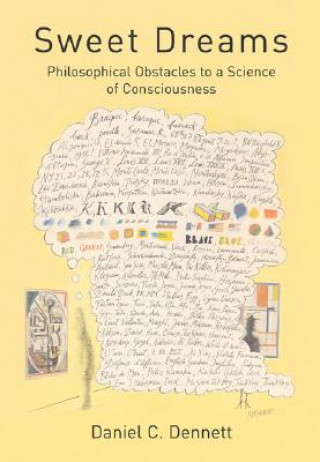
Książka Sweet Dreams Daniel C. Dennett

Sweet Dreams

Język: Angielski
Oprawa: Miękka
Wydawca: MIT Press Ltd
Dostępność: Dostępna u dostawcy
Wysyłamy za 8-11 dni
166.59
In the years since Daniel Dennett's influential Consciousness Explained was published in 1991, scien...
Informacje o książce

Język
Angielski
Oprawa
Książka - Miękka
Data wydania
2006
strony
216
EAN
9780262541916
ISBN
0262541912
Enbook ID
04044416
Wydawca
Waga
244
Wymiary
136 x 207 x 14

Pełny opis

In the years since Daniel Dennett's influential Consciousness Explained was published in 1991, scientific research on consciousness has been a hotly contested battleground of rival theories -- "so rambunctious," Dennett observes, "that several people are writing books just about the tumult." With Sweet Dreams, Dennett returns to the subject for "revision and renewal" of his theory of consciousness, taking into account major empirical advances in the field since 1991 as well as recent theoretical challenges.In Consciousness Explained, Dennett proposed to replace the ubiquitous but bankrupt Cartesian Theater model (which posits a privileged place in the brain where "it all comes together" for the magic show of consciousness) with the Multiple Drafts Model. Drawing on psychology, cognitive neuroscience, and artificial intelligence, he asserted that human consciousness is essentially the mental software that reorganizes the functional architecture of the brain. In Sweet Dreams, he recasts the Multiple Drafts Model as the "fame in the brain" model, as a background against which to examine the philosophical issues that "continue to bedevil the field." With his usual clarity and brio, Dennett enlivens his arguments with a variety of vivid examples. He isolates the "Zombic Hunch" that distorts much of the theorizing of both philosophers and scientists, and defends heterophenomenology, his "third-person" approach to the science of consciousness, against persistent misinterpretations and objections. The old challenge of Frank Jackson's thought experiment about Mary the color scientist is given a new rebuttal in the form of "RoboMary," while his discussion of a famous card trick, "The Tuned Deck," is designed to show that David Chalmers's Hard Problem is probably just a figment of theorists' misexploited imagination. In the final essay, the "intrinsic" nature of "qualia" is compared with the naively imagined "intrinsic value" of a dollar in "Consciousness -- How Much is That in Real Money?"

Możesz być zainteresowany

Consciousness Explained

Daniel C. Dennett
66.61
58.74

Daniel Dennett

David L Thompson
174.17
304.07
391.26

Kris Bryant

Jon M. Fishman
146.82

HOUGHTON MIFFLIN READING LEVEL

Houghton Mifflin Company
210.09
63.36

Rebel Sisters

Marita Conlon-McKenna
44.86

Fairy Tail 58

Hiro Mashima
40.34

Beez Brothers

Celeste Johnson
81.96

Epistle of Forgiveness

Abu L-ala Al-ma'arri
65.63
45.16
55.79

BLUE ANGEL ORACLE

SALERNO TONI CARMINE
93.08

Klienci, którzy kupili tę książkę, kupili również

231.74

Essential Difference

Simon Baron-Cohen
57.86
75.27
24.89

Zvířata v překladu

Temple Grandinová
39.65