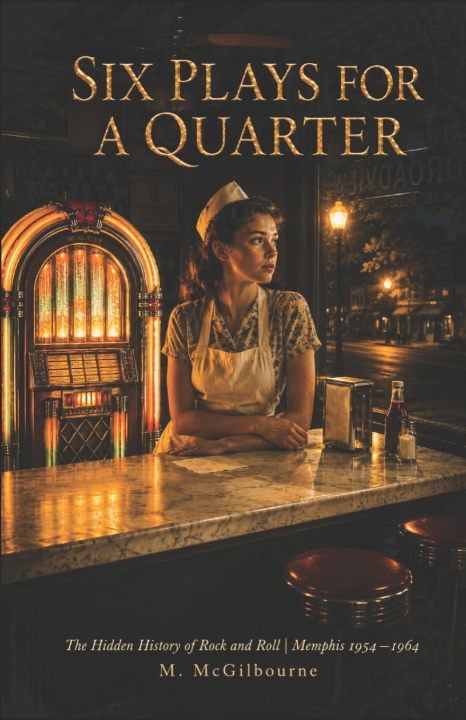
The Hidden History of Rock and Roll Memphis 1954-1964
Memphis, Tennessee. 1954-1964. Seventy-five million American teenagers. Pocket money. Transistor radios. A new kind of freedom nobody had legislated for. A city on the Mississippi where Black music and white radio crossed a line the law had tried to make permanent. A storefront on Union Avenue where a truck driver named Elvis Presley recorded a song that refused to be placed on either side of any line. The phone lines at WHBQ lit up within minutes. The music that changed the world was built on Black rhythm, gospel, and blues. Many of the artists who created it received a half-cent per record in royalties. The arguments about who rock and roll belonged to have never stopped.
Six Plays for a Quarter asks what it would have meant to be inside that moment.
Not as Elvis. Not as Sam Phillips. But as the ordinary girl - the soda fountain worker who kept the notebook, listened at midnight to a radio station she wasn't supposed to be receiving, and one afternoon heard a voice come through the jukebox wall and refuse to be placed.
- What did it actually cost to make the music that changed the world?
- Who built it - and who was paid for it?
- What happens when a wall is crossed in sound before it is crossed in law?
- What is the difference between a jukebox and a portal - when the people listening see no difference at all?
The documented facts are extraordinary enough.
July 5, 1954. Elvis Presley records That's All Right at Sun Records. DJ Dewey Phillips plays it three days later. The singer is unknown. By morning, he isn't.
WDIA Memphis - the first all-Black programmed radio station in America - broadcasts at 1070 on the dial. At midnight, the signal travels further. It crosses every wall the city has built.
1954. The transistor radio arrives. For the first time in history, a teenager can listen privately - under a pillow, in the dark, without permission.
December 4, 1956. Elvis, Johnny Cash, Carl Perkins, and Jerry Lee Lewis sing gospel around a piano at Sun Records while Sam Phillips leaves the tape running. The recording sits in a can for twenty-five years.
February 3, 1959. Buddy Holly, Ritchie Valens, and the Big Bopper die in an Iowa cornfield. Ritchie Valens is seventeen. He won his seat on the plane in a coin toss. Nobody who was not on that plane ever forgot the coin
Memphis in August smells of river and frying grease and pomade. The jukebox costs a nickel. The radio dial warms amber in the dark. You write the names down before someone tells you they are not yours to keep.
They were curious about the same things we are curious about. They built something that is still asking us questions. This book is the attempt of one ordinary witness - a girl who understood things by listening to them - to answer.
For homeschooling families: You are already doing the most important thing - putting the story of humanity directly into your children's hands. The Beyond His Story We Stand series was written for you. Each book takes one moment in human history and makes it lived rather than memorised, felt rather than filed away. Not a textbook. Not a syllabus. A story your child will not want to put down - and that will leave them asking the questions no curriculum can generate for them. The questions that only wonder produces.
The music crossed the wall before the law did. One person wrote it down. This is what was in the notebook.