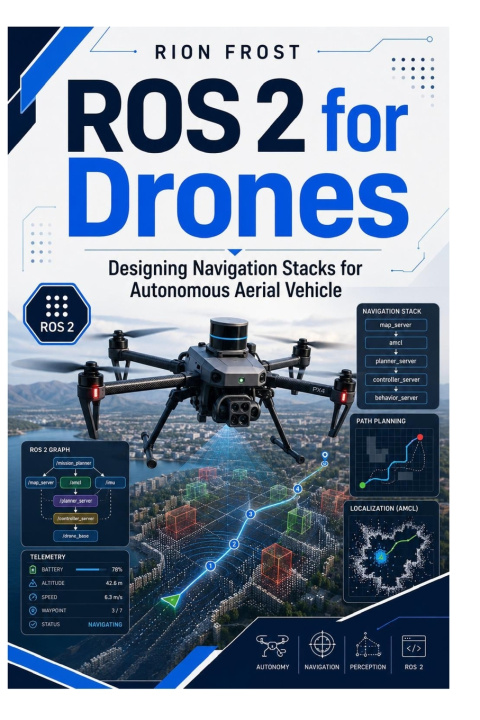
ROS 2 for Drones is a practical guide to designing navigation stacks for autonomous aerial vehicles using modern robotics software concepts.
This book explains how ROS 2 can support drone navigation, sensor integration, mission logic, localization, path planning, telemetry handling, and simulation-based testing. Instead of treating drone autonomy as a single feature, it shows how navigation behavior depends on many connected layers working together, including sensors, commands, control logic, onboard computers, middleware, and testing workflows.
Inside, readers will learn how to think about navigation-stack architecture, waypoint behavior, sensor data flow, localization methods, path planning, mission execution, telemetry monitoring, simulation validation, and safer testing before real flight. The focus is practical and engineering-minded, helping readers understand how autonomous aerial vehicle systems are organized and tested.
Written for robotics students, drone developers, Python learners, ROS 2 users, UAV builders, and autonomous-systems engineers, this guide provides a clear foundation for designing better drone navigation workflows.
Whether you are learning ROS 2, building drone software, testing navigation logic, or preparing autonomous missions in simulation, this book will help you understand how navigation stacks support safer and more reliable aerial robotics.
Buy this book today and start learning how to design ROS 2 navigation stacks for autonomous aerial vehicles.