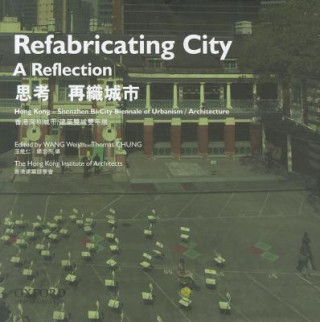
This publication is at once a record of and a reflection on the Biennale. The book consists of four main parts. The first part Forum features interviews with Ralph Lerner, Chang Yung-ho, Rocco Yim and Wang Weijen, as well as Leo Lee's interpretation, Zhu Tao's and Ruan Ching-Yue's critiques, Liu Jiakun's and Huang Sheng Yuan's reflections on the Biennale. We also invited twenty participants of the Biennale for their feedbacks, and the first members of the Steering Committee to share with us the origins of the Biennale. These various texts, by commenting on common issues such as the uniqueness of Hong Kong's urban spaces vs. the ordinariness of her architecture, the role and future of the Hong Kong-Shenzhen Biennale, historical buildings and the meaning of public space, provide us valuable references for strategizing on the future of our architecture and city. The second part Exhibition, which makes up the main content of this book, presents our visual record of all exhibits. The third part Venue and Event documents our understanding of the Central Police Station, the design and implementation, as well as the curatorial planning and program.
The fourth part is Lecture and Dialogue, which includes five main lectures and six dialogue events covering important topics related to the Biennale theme: refabrication and regeneration, memory and future, the global and the local, Hong Kong and Shenzhen, urbanism and landscape. In the course of editing this book, the 2009 Biennale has already launched in West Kowloon, and the direction of Central Police Station Compound and West Kowloon Planning has also became clearer. At the same time, citizen protests on the development of high-speed railway start to grip the attention of the Hong Kong media. This reminds us of the situation on the eve of the Biennale opening two years ago, when conservation activists and the media questioned the usage of historical buildings as the venue for an architecture biennale. In dealing with this crisis, we came to realize that what we were faced with were our frustrated citizens, who suffered chronically under the hegemony of procedural rationality, and who just had the urban memory of Star Ferry and Queen's Pier wiped out.
We requested our exhibiters to amend their exhibit design in the last minute to leave intact any of the internal furnishings, not because we shared the nostalgic attitude of treating historical architecture as untouchable antiques, but because we believed this Biennale also took part in the urban process of shaping our public space: it was an urban process of consensus-building and negotiation for a shared urban value. If every biennale could become an urban process of what Michel de Certeau theorized as the "practice of everyday life", it could certainly in many ways inspire our cultural imagination on space. Through the exhibits' interpretation and appropriation of a walled colonial prison compound, and the visitors' occupation of prison cells and courtyards, the 2007 Biennale engendered a double reading between architectural display and urban history. By setting up temporary exhibition structures and landscape in West Kowloon, the 2009 Biennale, opened up the public's experience, reflection and projection of this future cultural space.
By bringing our citizens into the exhibition venue, it is hoped that the Biennales will lead them to look into the spatial possibilities of the architecture: In what form should the public space take? What kind of cultural forum should it provide? What sort of strategy on public space will the government's new proposals offer? Whether it is the Biennale at Central Police Station or at the West Kowloon, through an urban processes of exploration in public space and participation in cultural forums, would our citizens be able to generate discourses to counter or negotiate with the procedural rationality, therefore be ready to state clearly what is needed for our city is more than an iconic landmark, but a public realm that allows everyone to interchange on all levels?