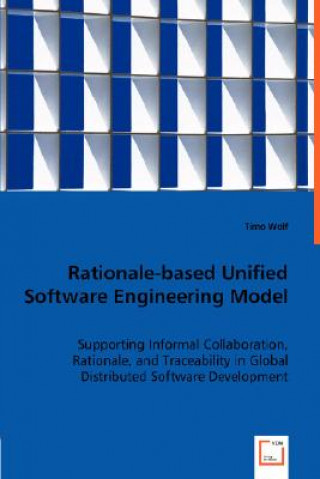
Książka Rationale-based Unified Software Engineering Model Timo Wolf

Rationale-based Unified Software Engineering Model

Autor: Timo Wolf
Język: Angielski
Oprawa: Miękka
Dostępność: Dostępna u dostawcy
Wysyłamy za 9-15 dni
253.15
This work addresses two problems of distributed software development projects: Inconsistencies betwe...


Informacje o książce

Autor
Język
Angielski
Oprawa
Książka - Miękka
Data wydania
2008
strony
160
EAN
9783836479509
ISBN
3836479508
Enbook ID
07148992
Waga
222
Wymiary
152 x 229 x 9

Pełny opis

This work addresses two problems of distributed software development projects: Inconsistencies between related artifacts such as documents and models and inefficient collaboration of distributed project participants. In particular informal communication is reduced and project knowledge gets lost.§§We claim that a consistent representation, supporting a unified data model for all documents and models including collaboration artifacts, helps to overcome these problems. As all artifacts are represented in one unified model, it is possible to implicitly capture dependency traces, which support consistency of related artifacts. Informal collaboration artifacts, such as comments, and formal discussions for representing rationale, are externalized and also part of the unified data model.§§We describe an extendable meta-model as a single consistent representation. Based on the meta-model we introduce the RUSE model, which integrates system, collaboration and organizational models. The models are realized in a tool called Sysiphus, which was used in academic and industrial software development projects. Selected projects are used to evaluate the proposed concepts. This work addresses two problems of distributed software development projects: Inconsistencies between related artifacts such as documents and models and inefficient collaboration of distributed project participants. In particular informal communication is reduced and project knowledge gets lost.§We claim that a consistent representation, supporting a unified data model for all documents and models including collaboration artifacts, helps to overcome these problems. As all artifacts are represented in one unified model, it is possible to implicitly capture dependency traces, which support consistency of related artifacts. Informal collaboration artifacts, such as comments, and formal discussions for representing rationale, are externalized and also part of the unified data model.§We describe an extendable meta-model as a single consistent representation. Based on the meta-model we introduce the RUSE model, which integrates system, collaboration and organizational models. The models are realized in a tool called Sysiphus, which was used in academic and industrial software development projects. Selected projects are used to evaluate the proposed concepts.

Możesz być zainteresowany

Quick Action

Robert W Chambers
33.24

Evoke

Jim Freeman
84.96

Open Adoption Triad

LCPC LMHC NCC E-RYT Dr VanderSchaaf
81.66
1 688.03
104.02

Bonnie Tyler

Bonnie Tyler
66.00

Marketing Luxury Services

Miguel Angelo Hemzo
247.22
684.91
55.31

Model Home

Rivers Solomon
50.93

Foundations

Kate Canterbary
13.60
108.78

Cotswolds

Dominic North
35.77

Klienci, którzy kupili tę książkę, kupili również

187.53
151.17

Katharina

Beate Penner
27.80

Caprichos

ENEKO MARTíNEZ GOIKOLEA
76.31
108.58
87.88

Estudios De Crítica Literaria; Volume 1

Marcelino Menendez Y. Pelayo
102.85
81.07