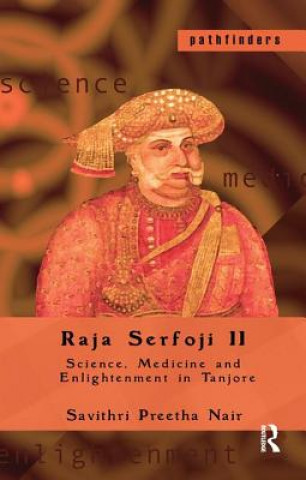
In the early nineteenth century, the south Indian kingdom of Tanjore, which had come under the control of the East India Company, flourished as a ‘centre’ of enlightenment. This book traces the contours of the Tanjore enlightenment, which produced a knowledge that was at once modern and deeply rooted in the indigenous tradition. The chief protagonist of this first ever full-length study on Tanjore at the turn of the nineteenth century is Raja Serfoji II (r. 1798–1832), in whose world science and God coexisted comfortably.
Tanjore at this time was a thriving contact-zone, linked to several centres through extensive local and global networks. Its court attracted a great number of visitors, including Christian missionaries, high-ranking Company officials, princely contemporaries, naturalists, and medical practitioners. Dwelling on the locatedness of science and enlightenment modernity in the context of the colonial periphery, the book describes how the Raja deployed certain ‘vectors of assemblage’ — an array of practices, instruments, theories and people, including his vast collection of manuscripts, books and scientific instruments, a Devanagari printing press, a menagerie, health establishments and a large retinue of trained experts and artists — to invent Tanjore as a contemporary ‘centre’.
Shunning reductionist and diffusionist explanations of the transmission of Western science in colonial settings, the study uses hitherto unexplored archival sources to reconstruct the Tanjore enlightenment as the outcome of globally situated cross-cultural exchanges. It celebrates the openness and confidence with which European science was engaged with, assimilated, translated and reinvented in a ‘contact-zone’ located in the colonial backwaters of south India.
The book will be of interest to historians, sociologists and those interested in history of science and medicine, anthropologists, cultural studies scholars, as well as the general reader.