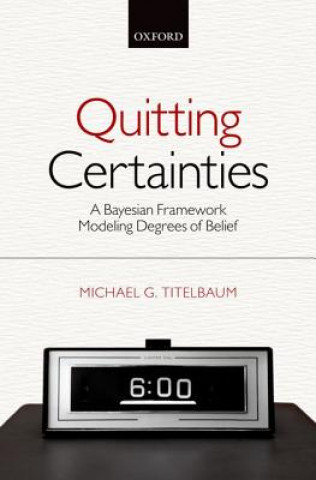
Książka Quitting Certainties Michael G. (University of Wisconsin-Madison) Titelbaum

Quitting Certainties

Język: Angielski
Oprawa: Twarda
Dostępność: 50 % szansa
Przeszukamy cały świat
549.57
Michael G. Titelbaum presents a new Bayesian framework for modeling rational degrees of belief, call...


Informacje o książce

Język
Angielski
Oprawa
Książka - Twarda
Data wydania
2012
strony
362
EAN
9780199658305
ISBN
0199658307
Enbook ID
02536735
Waga
698
Wymiary
163 x 240 x 24

Pełny opis

Michael G. Titelbaum presents a new Bayesian framework for modeling rational degrees of belief, called the Certainty-Loss Framework. Subjective Bayesianism is epistemologists' standard theory of how individuals should change their degrees of belief over time. But despite the theory's power, it is widely recognized to fail for situations agents face every day-cases in which agents forget information, or in which they assign degrees of belief to self-locating claims. Quitting Certainties argues that these failures stem from a common source: the inability of Conditionalization (Bayesianism's traditional updating rule) to model claims' going from certainty at an earlier time to less-than-certainty later on. It then presents a new Bayesian updating framework that accurately represents rational requirements on agents who undergo certainty loss. Titelbaum develops this new framework from the ground up, assuming little technical background on the part of his reader. He interprets Bayesian theories as formal models of rational requirements, leading him to discuss both the elements that go into a formal model and the general principles that link formal systems to norms. By reinterpreting Bayesian methodology and altering the theory's updating rules, Titelbaum is able to respond to a host of challenges to Bayesianism both old and new. These responses lead in turn to deeper questions about commitment, consistency, and the nature of information. Quitting Certainties presents the first systematic, comprehensive Bayesian framework unifying the treatment of memory loss and context-sensitivity. It develops this framework, motivates it, compares it to alternatives, then applies it to cases in epistemology, decision theory, the theory of identity, and the philosophy of quantum mechanics.

Możesz być zainteresowany

Teacher Wellbeing

Sarah Mercer
176.21

queen cook book

William Hart. Boyd
95.50
68.14

Profiling

Daniel Vernan
60.84

Time Management

Harvey Blackwell
83.43
59.77
58.40
375.59
235.89
56.94

Art From Her Heart

Kathy Whitehead
61.81

Dark and Bloody

Colonel Alonzo Fugate
87.71
423.49
64.54

Using Joomla

Ron Severdia
169.29

Klienci, którzy kupili tę książkę, kupili również