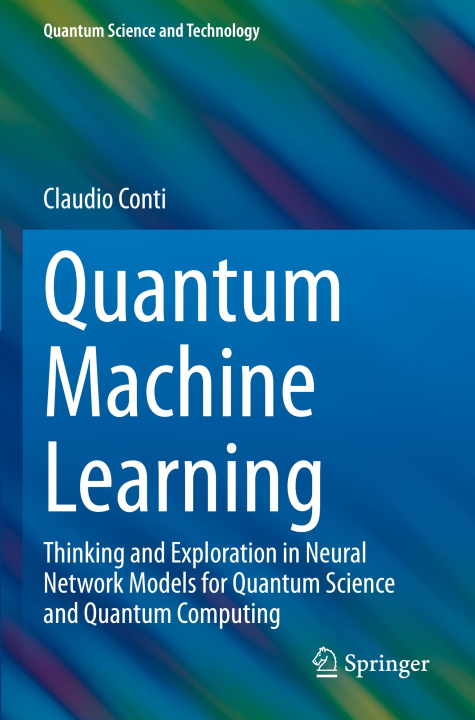
Książka Quantum Machine Learning Claudio Conti

Quantum Machine Learning

Autor: Claudio Conti
Język: Angielski
Oprawa: Miękka
Dostępność: Dostępna u dostawcy
Wysyłamy za 5-8 dni
549.29
This book presents a new way of thinking about quantum mechanics and machine learning by merging the...
Informacje o książce

Język
Angielski
Oprawa
Książka - Miękka
Data wydania
2025
strony
404
EAN
9783031442285
ISBN
3031442288
Enbook ID
47153916
Waga
610
Wymiary
155 x 235 x 22

Pełny opis

This book presents a new way of thinking about quantum mechanics and machine learning by merging the two. Quantum mechanics and machine learning may seem theoretically disparate, but their link becomes clear through the density matrix operator which can be readily approximated by neural network models, permitting a formulation of quantum physics in which physical observables can be computed via neural networks. As well as demonstrating the natural affinity of quantum physics and machine learning, this viewpoint opens rich possibilities in terms of computation, efficient hardware, and scalability. One can also obtain trainable models to optimize applications and fine-tune theories, such as approximation of the ground state in many body systems, and boosting quantum circuits' performance. The book begins with the introduction of programming tools and basic concepts of machine learning, with necessary background material from quantum mechanics and quantum information also provided. This enables the basic building blocks, neural network models for vacuum states, to be introduced. The highlights that follow include: non-classical state representations, with squeezers and beam splitters used to implement the primary layers for quantum computing; boson sampling with neural network models; an overview of available quantum computing platforms, their models, and their programming; and neural network models as a variational ansatz for many-body Hamiltonian ground states with applications to Ising machines and solitons. The book emphasizes coding, with many open source examples in Python and TensorFlow, while MATLAB and Mathematica routines clarify and validate proofs. This book is essential reading for graduate students and researchers who want to develop both the requisite physics and coding knowledge to understand the rich interplay of quantum mechanics and machine learning.

Możesz być zainteresowany

603.63
48.70

Taranta

Jose Duarte
188.40

Techlash

Tom Wheeler
91.96

Buried for Pleasure

Edmund Crispin
55.12

Torn Signs

William C. Agee
215.14

Crime and Punishment

Fyodor Dostoyevsky
68.92

Business Blockchain

William Mougayar
88.75

Innocent

Scott Turow
64.84
168.86

Ibn Khaldun

Allen James Fromherz
674.02
65.81

Stand in the Sun

Max Von Kreisler
142.91
145.72
616.85

Klienci, którzy kupili tę książkę, kupili również

Vamos a dormir

Esther Burgueo
20.31
31.68

O Selo de Salomao

Steven Savile
11.66
217.86
44.81

Un Puente a la Realidad

SERGI TORRES BALDÓ
68.72
55.70
118.31

Rette ...

Anne Wilhelm
55.70

Das Testkundenverfahren

Ariane Nürnberger
246.25
56.18

Viata Maicii Domnului

Horia Ion Groza
40.53
145.63
27.80
33.24
141.06