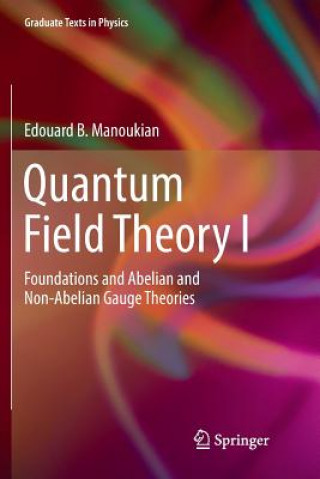
Książka Quantum Field Theory I EDOUARD B MANOUKIAN

Quantum Field Theory I

Foundations and Abelian and Non-Abelian Gauge Theories

Język: Angielski
Oprawa: Miękka
Dostępność: Dostępna u dostawcy
Wysyłamy za 5-8 dni
272.58
This textbook covers a broad spectrum of developments in QFT, emphasizing those aspects that are now...

Informacje o książce

Język
Angielski
Oprawa
Książka - Miękka
Data wydania
2018
strony
586
EAN
9783319809229
ISBN
9783319809229
Enbook ID
19784812
Waga
920
Wymiary
155 x 235 x 32

Pełny opis

This textbook covers a broad spectrum of developments in QFT, emphasizing those aspects that are now well consolidated and for which satisfactory theoretical descriptions have been provided. The book is unique in that it offers a new approach to the subject and explores many topics merely touched upon, if covered at all, in standard reference works. A detailed and largely non-technical introductory chapter traces the development of QFT from its inception in 1926. The elegant functional differential approach put forward by Schwinger, referred to as the quantum dynamical (action) principle, and its underlying theory are used systematically in order to generate the so-called vacuum-to-vacuum transition amplitude of both abelian and non-abelian gauge theories, in addition to Feynman's well-known functional integral approach, referred to as the path-integral approach. Given the wealth of information also to be found in the abelian case, equal importance is put on both abelian and non-abelian gauge theories. Particular emphasis is placed on the concept of a quantum field and its particle content to provide an appropriate description of physical processes at high energies, where relativity becomes indispensable. Moreover, quantum mechanics implies that a wave function renormalization arises in the QFT field independent of any perturbation theory - a point not sufficiently emphasized in the literature. The book provides an overview of all the fields encountered in present high-energy physics, together with the details of the underlying derivations. Further, it presents "deep inelastic" experiments as a fundamental application of quantum chromodynamics. Though the author makes a point of deriving points in detail, the book still requires good background knowledge of quantum mechanics, including the Dirac Theory, as well as elements of the Klein-Gordon equation. The present volume sets the language, the notation and provides additional background for reading Quantum Field Theory II - Introduction to Quantum Gravity, Supersymmetry and String Theory, by the same author. Students in this field might benefit from first reading the book Quantum Theory: A Wide Spectrum (Springer, 2006), by the same author.
Możesz być zainteresowany

Quantum Field Theory

Ronald (Radboud Universiteit Nijmegen) Kleiss
373.06
692.20
598.81
428.07
547.04
214.72
490.06
225.74
809.89

Primer on String Theory

SCHOMERUS VOLKER
187.56

Superstring Theory

Michael B. Green
294.04

Gravitation

Charles W. Misner
332.41
414.29
641.42

Klienci, którzy kupili tę książkę, kupili również

Quantum Field Theory II

Edouard B. Manoukian
376.99

Quantum Field Theory II

EDOUARD B MANOUKIAN
272.58

Quantum String Theory

Noboru Kawamoto
428.07
234.79

Quantum Field Theory

Thanu Padmanabhan
251.82

Quantum Field Theory I

Edouard B. Manoukian
376.99
278.98
512.60

Quantum Field Theory

Mark Srednicki
365.18
562.89

Quantum Field Theory

Michael V. Sadovskii
791.39

String Theory

Joseph Polchinski
690.33
628.53
251.82

String Theory

Joseph Polchinski
690.33
251.82
390.57