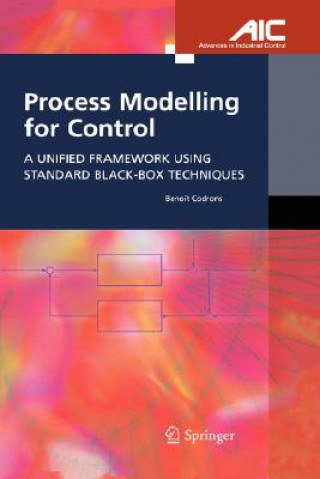
Książka Process Modelling for Control Benoît Codrons

Process Modelling for Control

A Unified Framework Using Standard Black-box Techniques

Język: Angielski
Oprawa: Twarda
Dostępność: Dostępna u dostawcy
Wysyłamy za 10-13 dni
634.56
Process Modelling for Control concentrates on the modelling steps underlying a successful control de...


Informacje o książce

Język
Angielski
Oprawa
Książka - Twarda
Data wydania
2005
strony
229
EAN
9781852339180
ISBN
1852339187
Enbook ID
01435390
Waga
1210
Wymiary
155 x 235 x 19

Pełny opis

Process Modelling for Control concentrates on the modelling steps underlying a successful control design, answering questions like:§How should I carry out the identification of my process to obtain a good model?§How can I assess the quality of a model before to using it in control design?§How can I ensure that a controller will stabilise a real process well enough before implementation?§What is the most efficient method of order reduction to simplify the implementation of high-order controllers?§System identification, model/controller validation and order reduction are studied in a common framework. Detailed worked examples, representative of various industrial applications, are given.§This monograph uses mathematics convenient to researchers interested in real applications and to practising engineers interested in control theory. It enables control engineers to improve their methods and provides academics and graduate students with an all-round view of recent results in modelling for control.Many process control books focus on control design techniques, taking the construction of a process model for granted. Process Modelling for Control concentrates on the modelling steps underlying a successful design, answering questions like:§How should I carry out the identification of my process in order to obtain a good model?§How can I assess the quality of a model with a view to using it in control design?§How can I ensure that a controller will stabilise a real process sufficiently well before implementation?§What is the most efficient method of order reduction to facilitate the implementation of high-order controllers?§Different tools, namely system identification, model/controller validation and order reduction are studied in a framework with a common basis: closed-loop identification with a controller that is close to optimal will deliver models with bias and variance errors ideally tuned for control design. As a result, rules are derived, applying to all the methods, that provide the practitioner with a clear way forward despite the apparently unconnected nature of the modelling tools. Detailed worked examples, representative of various industrial applications, are given: control of a mechanically flexible structure; a chemical process; and a nuclear power plant.§Process Modelling for Control uses mathematics of an intermediate level convenient to researchers with an interest in real applications and to practising control engineers interested in control theory. It will enable working control engineers to improve their methods and will provide academics and graduate students with an all-round view of recent results in modelling for control.Many process control books focus on control design techniques, taking the construction of a process model for granted. Process Modelling for Control concentrates on the modelling steps underlying a successful design, answering questions like: §How should I carry out the identification of my process in order to obtain a good model? §How can I assess the quality of a model with a view to using it in control design? §How can I ensure that a controller will stabilise a real process and achieve a pre-specified level of performance before implementation? §What is the most efficient method of order reduction to facilitate the implementation of high-order controllers? §Different tools, namely system identification, model/controller validation and order reduction are studied in a framework with a common basis: closed-loop identification with a controller that is close to optimal will deliver models with bias and variance errors ideally tuned for control design. As a result, rules are derived, applying to all the methods, that provide the practitioner with a clear way forward despite the apparently unconnected nature of the modelling tools. Detailed worked examples, representative of various industrial applications, are given: control of a mechanically flexible structure; a chemical process; and a nuclear power plant.§Process Modelling for Control uses mathematics of an intermediate level convenient to researchers with an interest in real applications and to practising control engineers interested in control theory. It will enable working control engineers to improve their methods and will provide academics and graduate students with an all-round view of recent results in modelling for control. §Advances in Industrial Control aims to report and encourage the transfer of technology in control engineering. The rapid development of control technology has an impact on all areas of the control discipline. The series offers an opportunity for researchers to present an extended exposition of new work in all aspects of industrial control.

Możesz być zainteresowany

785.47

Spanish Notebook

Christopher Buckley
64.73
66.58

Hinterland

Jamie Bulloch
82.94
105.72

Handwriting for Preschoolers

Designs Finesse Protocol Designs
45.75

Israel

Kristine Spanier
45.55

Knowing He's There

Charles Sacchetti
77.00

Breaking Point

Dylan Rogers
52.47

Mirabilis

Karl P N Shuker
79.53
64.93
212.42
32.31

Klienci, którzy kupili tę książkę, kupili również

Das Denken in Standards.

Karl-Heinz Strache
155.28

Geschichte Der Deutschen Universitäten

Richard Maria Ferdi... Du Moulin-Eckart
122.37