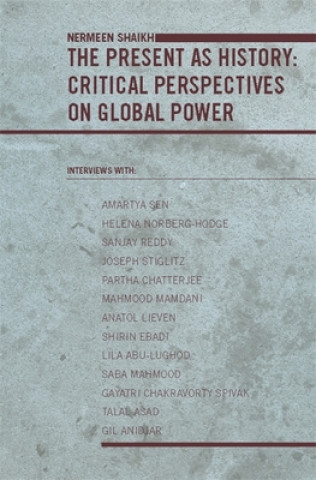
Książka Present as History Nermeen Shaikh

Present as History

Critical Perspectives on Global Power

Język: Angielski
Oprawa: Miękka
Dostępność: Dostępna u dostawcy
Wysyłamy za 14-21 dni
157.15
The Present as History is a rare opportunity to hear world-renowned scholars speak on the new imperi...
Informacje o książce

Język
Angielski
Oprawa
Książka - Miękka
Data wydania
2007
strony
296
EAN
9780231142991
ISBN
0231142994
Enbook ID
04558578
Waga
390
Wymiary
152 x 229 x 15

Pełny opis

The Present as History is a rare opportunity to hear world-renowned scholars speak on the new imperialism, feminism and human rights, secularism and Islam, post-colonialism, and the global economy. They treat the United States as an object to be historically and politically interrogated rather than as the norm from which all else is to be evaluated and assess the Third World through its history of colonialism and neocolonialism rather than focusing on issues of culture and morality. Amartya Sen discusses the shortcomings of the development agenda as it was conceived at the close of the Second World War, while Joseph Stiglitz explains economic globalization and the power of the International Monetary Fund in guiding its trajectory. Sanjay Reddy argues that global poverty estimates are flawed, and Helena Norberg-Hodge uses her experience in Tibet to lay bare the problems with development practice. Political scientists Partha Chatterjee, Mahmood Mamdani, and Anatol Lieven chart the growth of hegemonic power from the colonial to the postcolonial period. Chatterjee examines the enduring effects of colonial administrative and governing practices, while Mamdani, focusing on the present global dispensation, explains the growth of terrorist movements around the world in the context of the Cold War. Lieven looks at the different strains of American nationalism and the continuities and ruptures between nineteenth-century empires and the present one. Iranian human rights lawyer Shirin Ebadi elaborates the relationship between Islam, democracy, and human rights while anthropologists Lila Abu-Lughod and Saba Mahmood respectively trace the historical use of women as an excuse for imperial intervention and discuss the relationship between liberalism, Islam, and secularism. Literary theorist and cultural critic Gayatri Chakravorty Spivak looks at the legacy of colonialism in the domain of language and education, and isolates the problems associated with human rights discourse and practice. In conclusion, Talal Asad traces the genealogy of the term secularism, the special place of Islam within it, and its relationship to modernity. Gil Anidjar considers the distinction between religion and politics and elaborates the historical links between secularism and Christianity. Taken together, these interviews offer a valuable understanding of world history and a corrective to predominant conventional discourses on global power and justice.

Możesz być zainteresowany

696.33

Movie Log Book

Amy Newton
84.33
428.07

Fresh Complaint

Jeffrey Eugenides
104.80
46.34

The Gypsy

Steven Brust
56.48

Whistle for Willie

Ezra Jack Keats
31.97

Gypsies

Charles G Leland
123.69

Breast Carcinoma

Alok Kumar Singh
181.85

Fairy Tail 31

Hiro Mashima
49.29

On Liberty

John Stuart Mill
86.39

Cantona

Philippe Auclair
88.26

Klienci, którzy kupili tę książkę, kupili również

Ashokudu

Anonymous
76.45

Jujutsu Kaisen 10

Gege Akutami
38.27

Ucubeler

Tess Gerritsen
63.07
141.21

Entzünde Azusa

Jennifer A. Miskov
66.12

Aktive Gedachtnis

Joachim Hoffmann
220.52