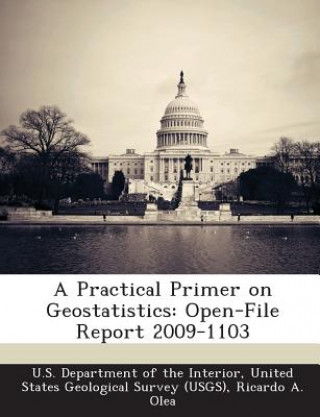
Książka Practical Primer on Geostatistics Senior Scientist Ricardo A (Kansas Geological Survey) Olea

Practical Primer on Geostatistics

Open-File Report 2009-1103

Język: Angielski
Oprawa: Miękka
Wydawca: Bibliogov
Dostępność: Dostępna u dostawcy
Wysyłamy za 14-21 dni
134.68
THE CHALLENGE Most geological phenomena are extraordinarily complex in their interrelationships and...

Informacje o książce

Język
Angielski
Oprawa
Książka - Miękka
Data wydania
2013
strony
352
EAN
9781288689927
ISBN
9781288689927
Enbook ID
08272411
Wydawca
Waga
630
Wymiary
189 x 246 x 19

Pełny opis

THE CHALLENGE Most geological phenomena are extraordinarily complex in their interrelationships and vast in their geographical extension. Ordinarily, engineers and geoscientists are faced with corporate or scientific requirements to properly prepare geological models with measurements involving a small fraction of the entire area or volume of interest. Exact description of a system such as an oil reservoir is neither feasible nor economically possible. The results are necessarily uncertain. Note that the uncertainty is not an intrinsic property of the systems; it is the result of incomplete knowledge by the observer. THE AIM OF GEOSTATISTICS The main objective of geostatistics is the characterization of spatial systems that are incompletely known, systems that are common in geology. A key difference from classical statistics is that geostatistics uses the sampling location of every measurement. Unless the measurements show spatial correlation, the application of geostatistics is pointless. Ordinarily the need for additional knowledge goes beyond a few points, which explains the display of results graphically as fishnet plots, block diagrams, and maps. GEOSTATISTICAL METHODS Geostatistics is a collection of numerical techniques for the characterization of spatial attributes using primarily two tools: probabilistic models, which are used for spatial data in a manner similar to the way in which time-series analysis characterizes temporal data, or pattern recognition techniques. The probabilistic models are used as a way to handle uncertainty in results away from sampling locations, making a radical departure from alternative approaches like inverse distance estimation methods. DIFFERENCES WITH TIME SERIES On dealing with time-series analysis, users frequently concentrate their attention on extrapolations for making forecasts. Although users of geostatistics may be interested in extrapolation, the methods work at their best interpolating. This simple difference has sig

Możesz być zainteresowany

Kingdom

Fuminori Nakamura
58.38
64.78

Why Lincoln Laughed

Russell H. Conwell
50.50
71.28
126.81

Cities of Refuge

John M McVey
106.23

Lost Words

Saheli Mitra
30.71

Cyclops

Euripides
72.55

Leaving Home

David P. Celani
147.98

Instant Economist

John Charles Pool
71.28

Klienci, którzy kupili tę książkę, kupili również

Sefiller

Victor Hugo
75.31
64.98

Flotila nožů

Gereth L. Powel
46.07