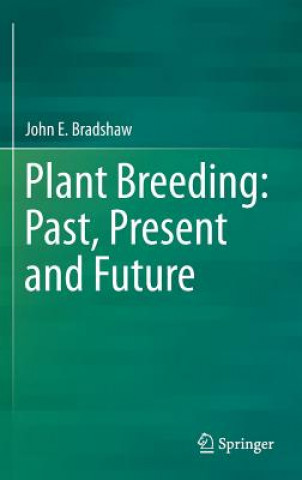
Książka Plant Breeding: Past, Present and Future John E. Bradshaw

Plant Breeding: Past, Present and Future

Język: Angielski
Oprawa: Twarda
Dostępność: Dostępna u dostawcy
Wysyłamy za 10-13 dni
949.84
This book aims to help plant breeders by reviewing past achievements, currently successful practices...

Informacje o książce

Język
Angielski
Oprawa
Książka - Twarda
Data wydania
2016
strony
693
EAN
9783319232843
ISBN
3319232843
Enbook ID
09486297
Waga
1230
Wymiary
241 x 167 x 45

Pełny opis

This book aims to help plant breeders by reviewing past achievements, currently successful practices, and emerging methods and techniques. Theoretical considerations are also presented to strike the right balance between being as simple as possible but as complex as necessary.§§The United Nations predicts that the global human population will continue rising to 9.0 billion by 2050. World food production will need to increase between 70-100 per cent in just 40 years. First generation bio-fuels are also using crops and cropland to produce energy rather than food. In addition, land area used for agriculture may remain static or even decrease as a result of degradation and climate change, despite more land being theoretically available, unless crops can be bred which tolerate associated abiotic stresses. Lastly, it is unlikely that steps can be taken to mitigate all of the climate change predicted to occur by 2050, and beyond, and hence adaptation of farming systems and crop production will be required to reduce predicted negative effects on yields that will occur without crop adaptation. Substantial progress will therefore be required in bridging the yield gap between what is currently achieved per unit of land and what should be possible in future, with the best farming methods and best storage and transportation of food, given the availability of suitably adapted cultivars, including adaptation to climate change. My book is divided into four parts: Part I is an historical introduction; Part II deals with the origin of genetic variation by mutation and recombination of DNA; Part III explains how the mating system of a crop species determines the genetic structure of its landraces; Part IV considers the three complementary options for future progress: use of sexual reproduction in further conventional breeding, base broadening and introgression; mutation breeding; and genetically modified crops.§§
Możesz być zainteresowany

863.74
132.73

Twin Flame Reignition

MICHELLE GORDON
61.44

Clandestine Incandescence

Stephen Donald Huff
81.03

Sufi Parables

Anna Zubkova
33.50
58.46
50.10
112.25

Game of Thrones

Insight Editions
53.98

IN THE FOOTSTEPS OF CADILLAC

CLARENCE MON BURTON
112.94

Wheat Improvement

Hans-Joachim Braun
169.92

Engineering Natural Silk

Balasubramanian Kandasubramanian
863.74

Klienci, którzy kupili tę książkę, kupili również

280.08

nyugati szereto

Budai Lotti
28.82
84.51

Toleranz

Doris Wirth
16.79

Grundzuge Einer Systemtheorie

Jay Wright Forrester
283.37

Tajná invaze

Bendis Brian Michael
109.46
182.74
75.66

Blue

Regina Rothörl
71.48

Domani, domani

Francesca Giannone
25.64
54.98
115.23

Benoît XVI NE

Bernard Lecomte
72.18