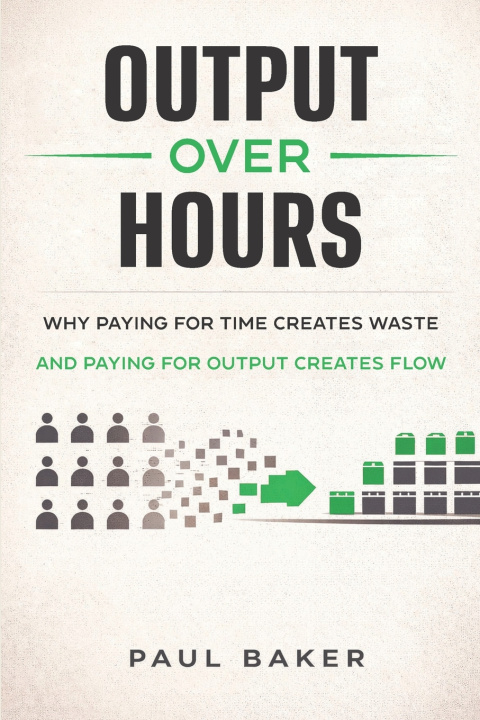
If you run a plant, warehouse, or fulfillment operation, your labor model is broken. You've been paying for hours. It's time to pay for output.
Across America, most plants, warehouses, and fulfillment operations manage labor the same way: hire by the hour, pay for time on the clock, and hope productivity follows. It is cost-plus in disguise. And the hidden costs - lost throughput, rework, overtime, turnover, and constant retraining - are often far higher than the rate on the invoice. The model punishes your best people, subsidizes your weakest performers, and bakes broken incentives into every level of the operation.
Output Over Hours is the playbook for replacing that model.
Paul Baker, CFO of Productiv, draws on more than two decades of operating experience and company-built data showing that paying for output outperforms paying for hours across factories, warehouses, and fulfillment environments. In this book, he lays out the full operating system: how to baseline Cost Per Unit, design lean production lines using single-piece flow, staff to the operation instead of to man-hours, set conveyor speeds for maximum throughput, build gainsharing programs that align financial incentives with floor performance, and create the servant-leadership culture that holds it all together.
This book is for COOs, VPs of Operations, and GMs who are tired of the temp-labor grind - no-shows, retraining, revolving doors, and constant instability - and who have tried everything from attendance bonuses to flexible schedules to rotating staffing agencies, only to end up with the same result: not enough reliable output on the floor. This is a practical playbook, not a thought experiment, filled with financial templates, tools, and systems you can apply in your operation right away.
The hourly labor model is broken. Better systems beat cheaper labor. Every time.