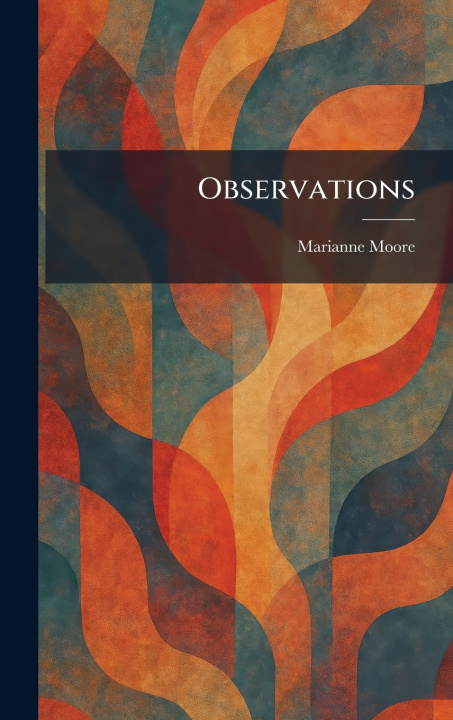
"Observations" is a foundational milestone in modernist literature, showcasing the sharp intellect and rhythmic innovation of Marianne Moore. This collection captures the essence of Moore's unique poetic voice, characterized by its meticulous precision, syllabic rigor, and an uncanny ability to find profound meaning in the minute details of the natural and material worlds.
Within these pages, readers encounter some of Moore's most celebrated works, including the iconic poem "Poetry," where she famously argues for a place for the "genuine" amidst the abstract. Her verses explore a wide array of subjects, from the biological intricacies of animal life to the complex social commentary found in the long poem "Marriage." Moore's work is noted for its intellectual depth, utilizing eclectic research and a distinct visual arrangement that challenged the poetic conventions of her era.
As one of the most significant figures of the 20th-century American avant-garde, Moore offers in "Observations" a masterclass in irony and formal discipline. This collection remains an essential text for anyone seeking to understand the evolution of American poetry and the power of language to transform ordinary subjects into extraordinary works of art.
This work has been selected by scholars as being culturally important, and is part of the knowledge base of civilization as we know it. This work was reproduced from the original artifact, and remains as true to the original work as possible. Therefore, you may see the original copyright references, library stamps (as most of these works have been housed in our most important libraries around the world), and other notations in the work.
This work is in the public domain in the United States of America, and possibly other nations. Within the United States, you may freely copy and distribute this work, as no entity (individual or corporate) has a copyright on the body of the work.
As a reproduction of a historical artifact, this work may contain missing or blurred pages, poor pictures, errant marks, etc. Scholars believe, and we concur, that this work is important enough to be preserved, reproduced, and made generally available to the public. We appreciate your support of the preservation process, and thank you for being an important part of keeping this knowledge alive and relevant.