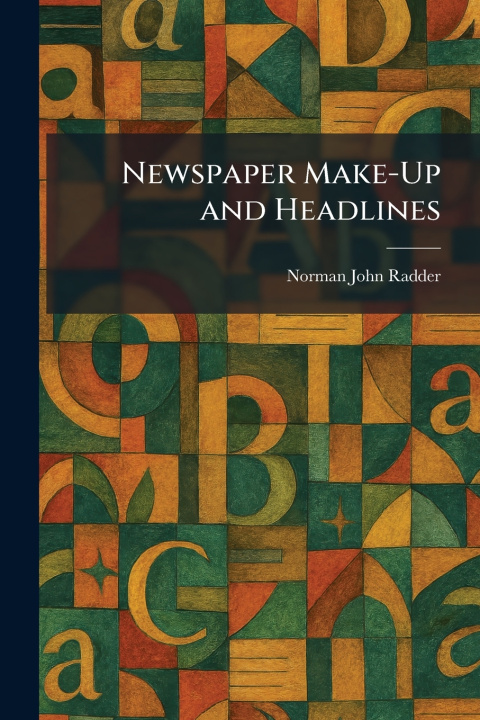
"Newspaper Make-Up and Headlines" is a comprehensive exploration of the technical and artistic elements that define effective newspaper presentation. This work serves as an instructional guide for journalists and editors, focusing on the critical roles of page layout and headline construction in print media during a formative era of professional reporting.
The text provides detailed insights into the principles of typography, the selection of typefaces, and the strategic arrangement of news items to maximize readability and visual impact. Author Norman John Radder examines the various styles of newspaper "make-up," offering a look at how different designs influence the reader's perception of news priority and importance. Beyond the visual aspects, the book offers a rigorous study of headline writing, emphasizing the need for clarity, punch, and linguistic precision within the tight physical constraints of the printed column.
As a foundational text in the history of journalism, "Newspaper Make-Up and Headlines" captures the professional standards and aesthetic values of the early 20th-century press. It remains a significant resource for understanding the evolution of media design, providing a bridge between traditional printing techniques and the core principles of visual communication that continue to influence the industry.
This work has been selected by scholars as being culturally important, and is part of the knowledge base of civilization as we know it. This work was reproduced from the original artifact, and remains as true to the original work as possible. Therefore, you may see the original copyright references, library stamps (as most of these works have been housed in our most important libraries around the world), and other notations in the work.
This work is in the public domain in the United States of America, and possibly other nations. Within the United States, you may freely copy and distribute this work, as no entity (individual or corporate) has a copyright on the body of the work.
As a reproduction of a historical artifact, this work may contain missing or blurred pages, poor pictures, errant marks, etc. Scholars believe, and we concur, that this work is important enough to be preserved, reproduced, and made generally available to the public. We appreciate your support of the preservation process, and thank you for being an important part of keeping this knowledge alive and relevant.