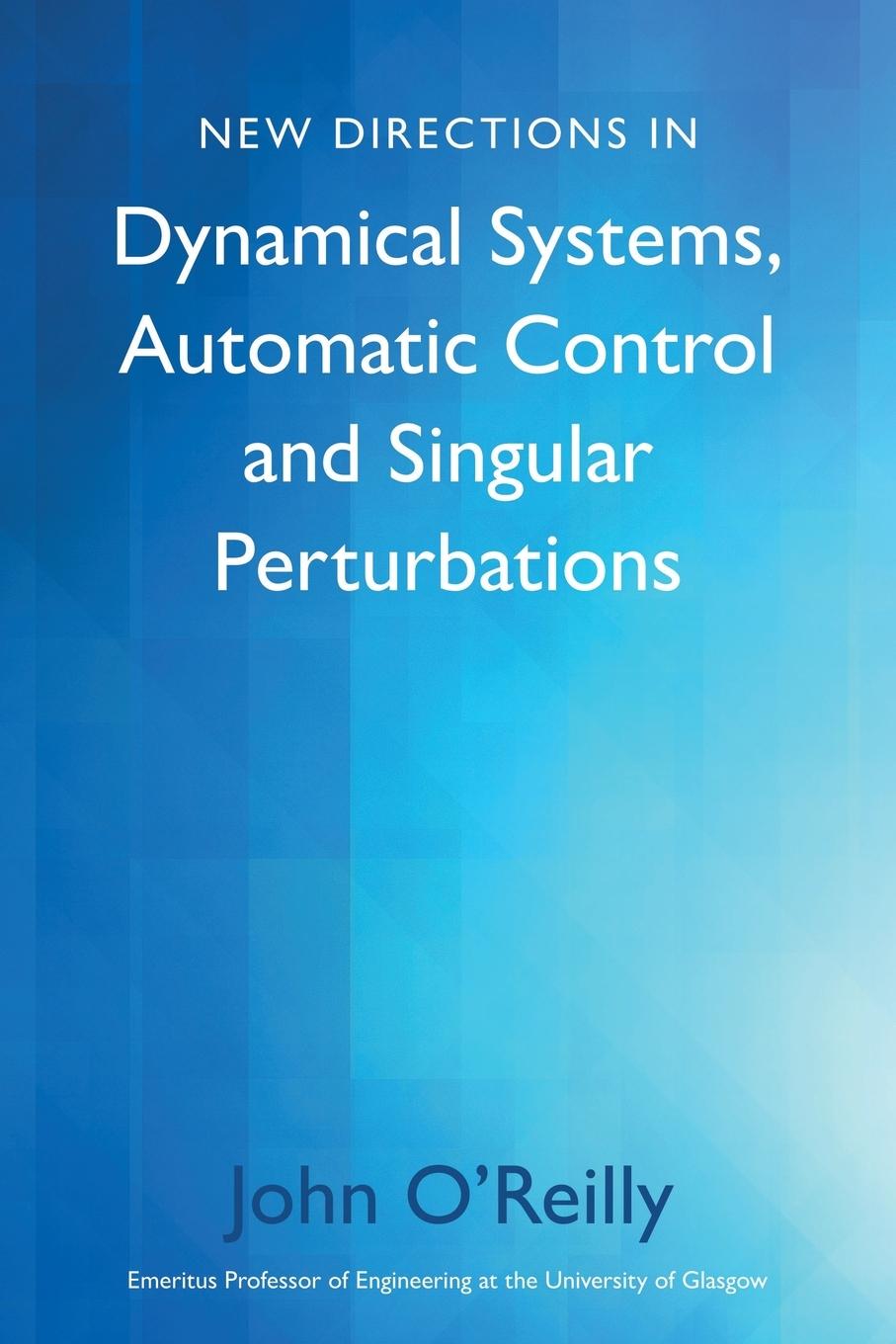
Książka New Directions in Dynamical Systems, Automatic Control and Singular Perturbations JOHN O'REILLY

New Directions in Dynamical Systems, Automatic Control and Singular Perturbations

Autor: JOHN O'REILLY
Język: Angielski
Oprawa: Miękka
Dostępność: Dostępna u dostawcy
Wysyłamy za 14-21 dni
53.21
With this short book, Professor O''Reilly brings his considerable engineering experience to bear upo...


Informacje o książce

Język
Angielski
Oprawa
Książka - Miękka
Data wydania
2022
strony
128
EAN
9781803132013
ISBN
1803132019
Enbook ID
38501684
Waga
234
Wymiary
234 x 156 x 13

Pełny opis

With this short book, Professor O''Reilly brings his considerable engineering experience to bear upon three subjects close to his heart: dynamical systems, automatic control and singular perturbations. New results of a fundamental and unifying nature are presented in all three areas. New directions are thereby established. Due care is taken of historical context and motivations. This highly readable book with its compelling physical narrative is divided into two parts, Part 1 and Part 2, for the reader’s convenience. Aimed primarily at engineers, this unusually affordable book should be read by every postgraduate.


Part 1 sets out the fundamental conditions that small-signal physically realisable dynamical system models must satisfy. These fundamental conditions are causality and non-singularity. They apply to all small-signal dynamical system models, as for example arise in electrical networks. Another important example is automatic control. Part 1 of this book also re-interprets the classic works of Nyquist and Bode to establish that the uncontrolled system must also not be singular; nor must the controlled system encounter singularity. But Part 1 goes much further. It shows that these fundamental properties, in particular non-singularity, must obtain for all small-signal system models regardless of how many inputs and outputs the system happens to have. So, small-signal automatic control for instance is all of a piece. It is that simple.

As for singular perturbations in Part 2, these little fellows simply pop up all over the place, sometimes where you least expect them. New associated low-frequency and high-frequency system transfer-function models are presented with almost insolent ease. Part 2 achieves for the frequency domain what standard singular perturbation theory does for the time domain. Moreover, even the standard nonlinear singularly perturbed system model does not escape scrutiny. Which model to choose? It could be important. Part 2 is an indispensable aid to modellers across the engineering spectrum seeking generic low-frequency and high-frequency models for what they do.

Możesz być zainteresowany

Roman Coins, Elementary Manual ..

Francesco 1847-1919 Gnecchi
139.91

Poisonous Mushroom

Thomas Dalton
76.81

The Double Date

Lindsay Anderson
28.23

Urban Systems Design

Yoshiki Yamagata
595.99
341.63

Revival

Stephen King
55.29
58.05

Speaking of Siva

A K Ramanujan
58.05
260.57
40.28
313.69

Klienci, którzy kupili tę książkę, kupili również

Skanzeny

Petr Dvořáček
58.54
68.71
53.21
63.58

Energie Und Entropie

Wilhelm Lehmann
301.45
204.19

DIES IRAE

KRZYSZTOF PENDERECKI
273.30
126.97

Chakozy

Sissoko
66.84
133.88
52.52