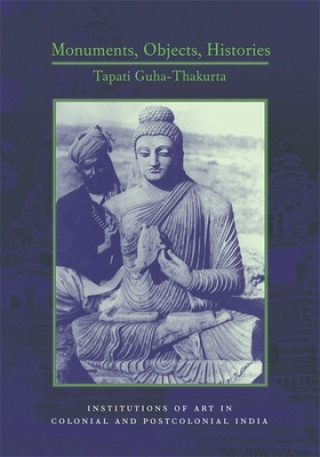
Książka Monuments, Objects, Histories Tapati Guha-Thakurta

Monuments, Objects, Histories

Institutions of Art in Colonial and Post-Colonial India

Język: Angielski
Oprawa: Twarda
Dostępność: Dostępna u dostawcy
Wysyłamy za 9-15 dni
494.47
Art history as it is largely practiced in Asia as well as in the West is a western invention. In Ind...


Informacje o książce

Język
Angielski
Oprawa
Książka - Twarda
Data wydania
2004
strony
432
EAN
9780231129985
ISBN
023112998X
Enbook ID
04558079
Waga
960
Wymiary
261 x 188 x 32

Pełny opis

Art history as it is largely practiced in Asia as well as in the West is a western invention. In India, works of art-sculptures, monuments, paintings-were first viewed under colonial rule as archaeological antiquities, later as architectural relics, and by the mid-20th century as works of art within an elaborate art-historical classification. Tied to these views were narratives in which the works figured, respectively, as sources from which to recover India's history, markers of a lost, antique civilization, and symbols of a nation's unique aesthetic, reflecting the progression from colonialism to nationalism. The nationalist canon continues to dominate the image of Indian art in India and abroad, and yet its uncritical acceptance of the discipline's western orthodoxies remains unquestioned, the original motives and means of creation unexplored. The book examines the role of art and art history from both an insider and outsider point of view, always revealing how the demands of nationalism have shaped the concept and meaning of art in India. The author shows how western custodianship of Indian "antiquities" structured a historical interpretation of art; how indigenous Bengali scholarship in the late 19th and early 20th centuries attempted to bring Indian art into the nationalist sphere; how the importance of art as a representation of national culture crystallized in the period after Independence; and how cultural and religious clashes in modern India have resulted in conflicting "histories" and interpretations of Indian art. In particular, the author uses the depiction of Hindu goddesses to elicit conflicting scenarios of condemnation and celebration, both of which have at their core the threat and lure of the female form, which has been constructed and narrativized in art history.

Możesz być zainteresowany

212.42

Bite the Bullet

Karley Brenna
38.93

Total Belief

Chris Evans
82.94
70.67
34.65
207.85

1968 in Canada

Andrew C. Holman
180.59

Family and it's Members

Anna Garlin Spencer
128.50

Tracking

Kerless Hopps
38.74
129.96

Megan Rapinoe

Jill Sherman
164.13

Un-Settling

MAGGIE MCREYNOLDS
49.64
125.19
30.27

Enabling Innovation

Sabina Jeschke
634.56
548.21

Sequential Analysis

Alexander Tartakovsky
966.26
73.20

Complete Poems

D. H. Lawrence
95.11

Klienci, którzy kupili tę książkę, kupili również

Dones vs. Obligaciones

Mario Vinicio Garza
46.53
57.24

Křehkost

Jan Váňa
48.28

luogo dell'anima

Hanni Münzer
63.37