Replacing the Traditional Physical Model Approach
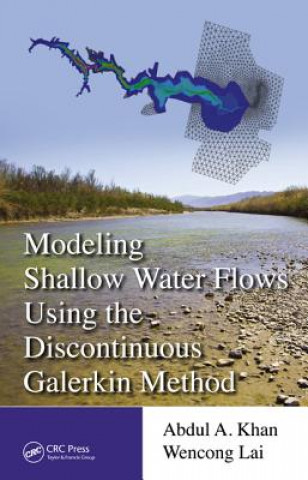
Computational models offer promise in improving the modeling of shallow water flows. As new techniques are considered, the process continues to change and evolve. Modeling Shallow Water Flows Using the Discontinuous Galerkin Method examines a technique that focuses on hyperbolic conservation laws and includes one-dimensional and two-dimensional shallow water flows and pollutant transports.
Combines the Advantages of Finite Volume and Finite Element Methods
This book explores the discontinuous Galerkin (DG) method, also known as the discontinuous finite element method, in depth. It introduces the DG method and its application to shallow water flows, as well as background information for implementing and applying this method for natural rivers. It considers dam-break problems, shock wave problems, and flows in different regimes (subcritical, supercritical, and transcritical).
Readily Adaptable to the Real World
While the DG method has been widely used in the fields of science and engineering, its use for hydraulics has so far been limited to simple cases. The book compares numerical results with laboratory experiments and field data, and includes a set of tests that can be used for a wide range of applications.
- Provides step-by-step implementation details
- Presents the different forms in which the shallow water flow equations can be written
- Places emphasis on the details and modifications required to apply the scheme to real-world flow problems
This text enables readers to readily understand and develop an efficient computer simulation model that can be used to model flow, contaminant transport, and other aspects in rivers and coastal environments. It is an ideal resource for practicing environmental engineers and researchers in the area of computational hydraulics and fluid dynamics, and graduate students in computational hydraulics.