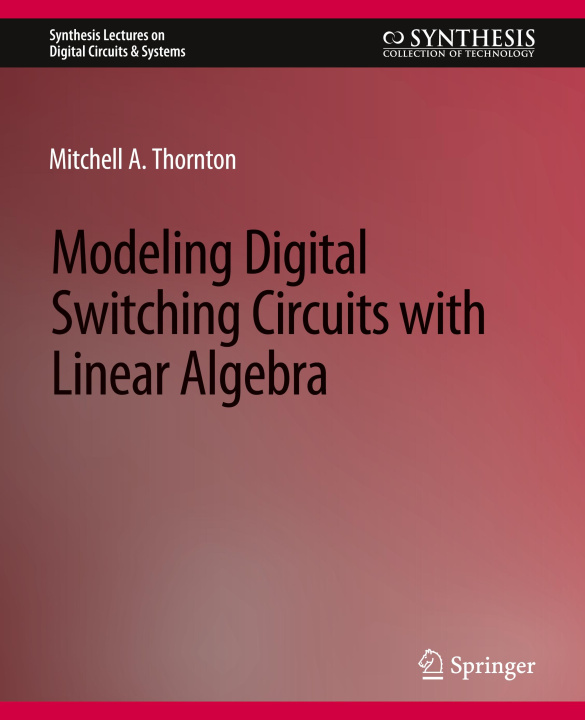
Książka Modeling Digital Switching Circuits with Linear Algebra Thornton

Modeling Digital Switching Circuits with Linear Algebra

Język: Angielski
Oprawa: Miękka
Dostępność: Dostępna u dostawcy
Wysyłamy za 5-8 dni
138.94
Modeling Digital Switching Circuits with Linear Algebra describes an approach for modeling digital i...

Informacje o książce

Język
Angielski
Oprawa
Książka - Miękka
Data wydania
2014
strony
145
EAN
9783031798665
ISBN
303179866X
Enbook ID
39298707
Waga
315
Wymiary
191 x 235 x 9

Pełny opis

Modeling Digital Switching Circuits with Linear Algebra describes an approach for modeling digital information and circuitry that is an alternative to Boolean algebra. While the Boolean algebraic model has been wildly successful and is responsible for many advances in modern information technology, the approach described in this book offers new insight and different ways of solving problems. Modeling the bit as a vector instead of a scalar value in the set {0, 1} allows digital circuits to be characterized with transfer functions in the form of a linear transformation matrix. The use of transfer functions is ubiquitous in many areas of engineering and their rich background in linear systems theory and signal processing is easily applied to digital switching circuits with this model. The common tasks of circuit simulation and justification are specific examples of the application of the linear algebraic model and are described in detail. The advantages offered by the new model as compared to traditional methods are emphasized throughout the book. Furthermore, the new approach is easily generalized to other types of information processing circuits such as those based upon multiple-valued or quantum logic; thus providing a unifying mathematical framework common to each of these areas.Modeling Digital Switching Circuits with Linear Algebra provides a blend of theoretical concepts and practical issues involved in implementing the method for circuit design tasks. Data structures are described and are shown to not require any more resources for representing the underlying matrices and vectors than those currently used in modern electronic design automation (EDA) tools based on the Boolean model. Algorithms are described that perform simulation, justification, and other common EDA tasks in an efficient manner that are competitive with conventional design tools. The linear algebraic model can be used to implement common EDA tasks directly upon a structural netlist thus avoiding the intermediate step of transforming a circuit description into a representation of a set of switching functions as is commonly the case when conventional Boolean techniques are used. Implementation results are provided that empirically demonstrate the practicality of the linear algebraic model.

Możesz być zainteresowany

641.42

Knowing and the Known

John 1859-1952 Dewey
104.11

Wipeout

Bryan Cassiday
76.55

The Conventionalists

Robert Hugh Benson
69.07

A Zombie Apocalypse

Keith Adam Luethke
29.02
85.51
214.72
30.40

Metallica

Hal Leonard Publishing Corporation
175.55
2 643.24

Space Viking

H Beam Piper
42.11
372.56

Klienci, którzy kupili tę książkę, kupili również

Innovative Regulierung

Martin Sonnenschein
157.35
79.90

Ik spreek 'honds'

Inge Pauwels
128.61

Vánoční prázdniny

Sophie Clairová
54.12

Prehistoria del mundo

Jorge Juan Eiroa
249.56
45.55