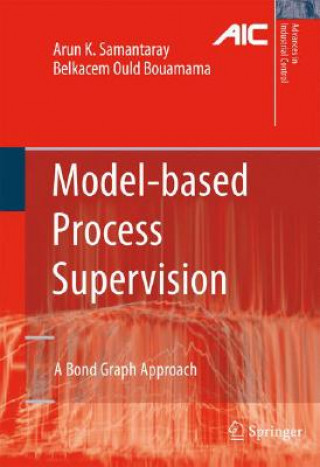
Książka Model-based Process Supervision Arun K. Samantaray

Model-based Process Supervision

A Bond Graph Approach

Język: Angielski
Oprawa: Twarda
Dostępność: Dostępna u dostawcy
Wysyłamy za 10-13 dni
634.56
This book provides control engineers and workers in industrial and academic research establishments...


Informacje o książce

Język
Angielski
Oprawa
Książka - Twarda
Data wydania
2008
strony
474
EAN
9781848001589
ISBN
1848001584
Enbook ID
01433866
Waga
1910
Wymiary
155 x 235 x 31

Pełny opis

This book provides control engineers and workers in industrial and academic research establishments interested in process engineering with a means to build up a practical and functional supervisory control environment and to use sophisticated models to get the best use out of their process data. Several applications to academic and small-scale-industrial processes are discussed and the development of a supervision platform for an industrial plant is presented.Model-based fault detection and isolation requires a mathematical model of the system behaviour. Modelling is important and can be difficult because of the complexity of the monitored system and its control architecture. The authors use bond-graph modelling, a unified multi-energy domain modelling method, to build dynamic models of process engineering systems by composing hierarchically arranged sub-models of various commonly encountered process engineering devices. The structural and causal properties of bond-graph models are exploited for supervisory systems design. §The structural properties of a system, necessary for process control, are elegantly derived from bond-graph models by following the simple algorithms presented here. Additionally, structural analysis of the model augmented with available instrumentation indicates directly whether it is possible to detect and/or isolate faults in some specific sub-space of the process. Such analysis aids in the design and resource optimization of new supervision platforms. §Static and dynamic constraints, which link the time evolution of the known variables under normal operation, are evaluated in real time to determine faults in the system. Various decision or post-processing steps integral to the supervisory environment are discussed in this monograph; they are required to extract meaningful data from process state knowledge because of unavoidable process uncertainties. Process state knowledge has been further used to take active and passive fault accommodation measures. §Several applications to academic and small-scale-industrial processes are interwoven throughout. Finally, an application concerning development of a supervision platform for an industrial plant is presented with experimental validation. §Model-based Process Supervision provides control engineers and workers in industrial and academic research establishments interested in process engineering with a means to build up a practical and functional supervisory control environment and to use sophisticated models to get the best use out of their process data.Model-based fault detection and isolation requires a mathematical model of the system behaviour. Modelling is important and can be difficult because of the complexity of the monitored system and its control architecture. The authors use bond-graph modelling, a unified multi-energy domain modelling method, to build dynamic models of process engineering systems by composing hierarchically arranged sub-models of various commonly encountered process engineering devices. The structural and causal properties of bond-graph models are exploited for supervisory systems design. §The structural properties of a system, necessary for process control, are elegantly derived from bond-graph models by following the simple algorithms presented here. Additionally, structural analysis of the model, augmented with available instrumentation, indicates directly whether it is possible to detect and/or isolate faults in some specific sub-space of the process. Such analysis aids in the design and resource optimization of new supervision platforms. §Static and dynamic constraints, which link the time evolution of the known variables under normal operation, are evaluated in real time to determine faults in the system. Various decision or post-processing steps integral to the supervisory environment are discussed in this monograph; they are required to extract meaningful data from process state knowledge because of unavoidable process uncertainties. Process state knowledge has been further used to take active and passive fault accommodation measures. §Several applications to academic and small-scale-industrial processes are interwoven throughout. Finally, an application concerning development of a supervision platform for an industrial plant is presented with experimental validation. §Model-based Process Supervision provides control engineers and workers in industrial and academic research establishments interested in process engineering with a means to build up a practical and functional supervisory control environment and to use sophisticated models to get the best use out of their process data.

Możesz być zainteresowany

74.27

PopCo

Scarlett Thomas
57.43

Time Slip

Aaron Olvera
37.76

ESV Journaling Bible

Crossway Bibles
183.99
51.69

Running Sideways

Pauline Davis
183.51

Sacred Earth, Sacred Soul

John Philip Newell
57.43

Poetry and Politics

Donald Holzman
195.39

Clique of Gold

Émile Gaboriau
84.59
37.18
49.64

Policing Across Borders

George Andreopoulos
423.49

Klienci, którzy kupili tę książkę, kupili również

71.06

Fieber in Urbicand

Benoit Peeters
86.35
48.09

Marienberg

Franz Aicher
86.83