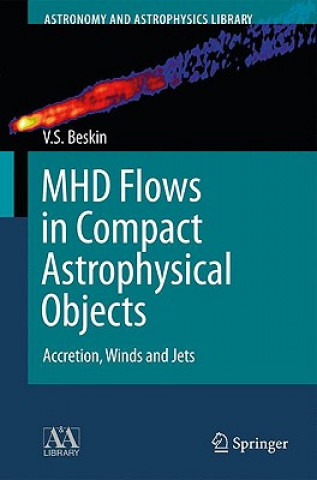
Książka MHD Flows in Compact Astrophysical Objects Vasily Beskin

MHD Flows in Compact Astrophysical Objects

Accretion, Winds and Jets

Autor: Vasily Beskin
Język: Angielski
Oprawa: Twarda
Dostępność: Dostępna u dostawcy
Wysyłamy za 10-13 dni
416.02
Accretion flows, winds and jets of compact astrophysical objects and stars are generally described w...


Informacje o książce

Język
Angielski
Oprawa
Książka - Twarda
Data wydania
2009
strony
425
EAN
9783642012891
ISBN
3642012892
Enbook ID
01649614
Waga
798
Wymiary
161 x 241 x 29

Pełny opis

Accretion flows, winds and jets of compact astrophysical objects and stars are generally described within the framework of hydrodynamical and magnetohydrodynamical (MHD) flows. Analytical analysis of the problem provides profound physical insights, which are essential for interpreting and understanding the results of numerical simulations. Providing such a physical understanding of MHD Flows in Compact Astrophysical Objects is the main goal of this book, which is an updated translation of a successful Russian graduate textbook. The book provides the first detailed introduction into the method of the Grad-Shafranov equation, describing analytically the very broad class of hydrodynamical and MHD flows. It starts with the classical examples of hydrodynamical accretion onto relativistic and nonrelativistic objects. The force-free limit of the Grad-Shafranov equation allows us to analyze in detail the physics of the magnetospheres of radio pulsars and black holes, including the Blandford-Znajek process of energy extraction from a rotating black hole immersed in an external magnetic field. Finally, on the basis of the full MHD version of the Grad-Shafranov equation the author discusses the problems of jet collimation and particle acceleration in Active Galactic Nuclei, radio pulsars, and Young Stellar Objects. The comparison of the analytical results with numerical simulations demonstrates their good agreement. Assuming that the reader is familiar with the basic physical and mathematical concepts of General Relativity, the author uses the 3+1 split approach which allows the formulation of all results in terms of physically clear language of three dimensional vectors. The book contains detailed derivations of equations, numerous exercises, and an extensive bibliography. It therefore serves as both an introductory text for graduate students and a valuable reference work for researchers in the field.

Możesz być zainteresowany

Atmosphere

Taylor Jenkins Reid
50.33

WIEDERGEBURT

Crystal Holdefer
68.42

Uni the Unicorn

Alexsandra L Petry
96.18
48.28
92.66

Klienci, którzy kupili tę książkę, kupili również

Hranice a deti

Henry Cloud
47.11
92.85
41.83
90.12
49.26
151.31
41.83
32.25

Adolphe

Benjamin Constant
66.66

Death Game

Yvonne Asmussen
37.72