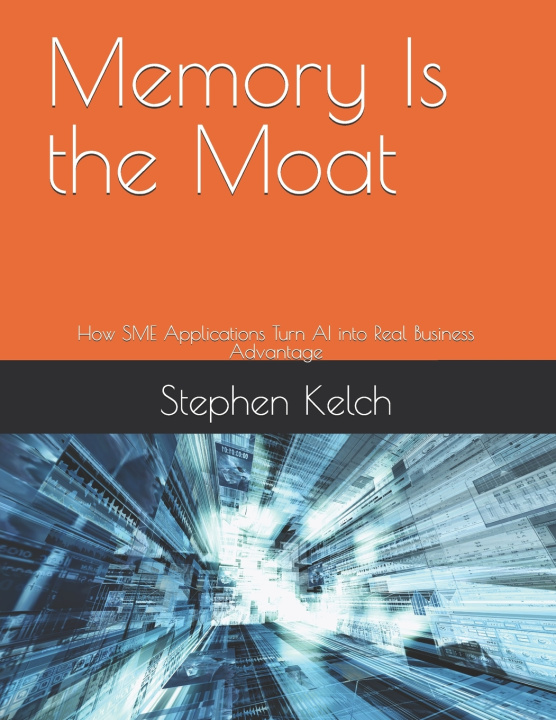
Książka Memory Is the Moat Stephen O Kelch

Memory Is the Moat

How SME Applications Turn AI into Real Business Advantage

Język: Angielski
Oprawa: Miękka
Dostępność: Zapowiedź
Wydanie 04. 04. 2026
86.17
Memory Is the Moat challenges the core assumption behind modern AI and enterprise software and repla...

Informacje o książce

Język
Angielski
Oprawa
Książka - Miękka
Data wydania
2026
strony
228
EAN
9798253675359
Enbook ID
51548963
Waga
540
Wymiary
216 x 280 x 12

Pełny opis

Memory Is the Moat challenges the core assumption behind modern AI and enterprise software and replaces it with a system that actually works.

Most organizations believe they have expertise.
Few can capture it.

Critical knowledge does not live in documentation, systems, or models. It lives in decisions and thousands of small, context-driven choices made by experienced professionals every day. Over time, those decisions compound into judgment. And when that judgment is not captured, it walks out the door.

This is not a technology gap.
It is a memory gap.

Today's software records what happened. It does not preserve why it happened. Generic AI can generate answers, but without memory, context, and constraints, those answers cannot be trusted in real-world decisions.

This book introduces a new category of system designed to solve that problem:
SME Applications.

SME Applications are not copilots or generic agents. They are domain-specific systems that:

capture decision history and institutional knowledge

apply structured reasoning under enforced rules

accumulate memory with every use

produce outputs professionals can trust

The advantage is not intelligence alone.
The advantage is memory and memory compounds.

Inside this book, you will learn:

Why most AI systems fail in production environments

The five-layer architecture required to make AI operational

How to design memory systems that improve with every decision

How to build reasoning engines that enforce consistency and trust

How to create a durable competitive advantage that cannot be replicated

This is not a theory book.
It is a design and execution guide.

Every concept is structured.
Every pattern is actionable.
Every decision is evaluated against a single standard:

Would a professional trust this output?

Organizations that build this way create systems that improve over time, preserve expertise, and scale judgment. Those that do not will continue to depend on individuals, lose knowledge, and accept inconsistency.

The next wave of advantage will not come from better models.
It will come from systems that remember.

This book shows you how to build them.