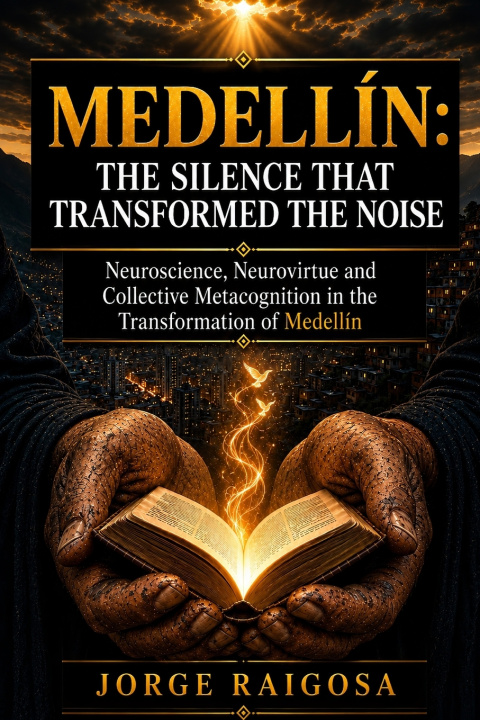
In 1991, Medellín had the highest peacetime homicide rate on the planet. In 2027, UNESCO designates it World Book Capital. Between those two dates lies one of the most remarkable urban transformations in contemporary history - and one of the least understood. This book is the scientific and human explanation of how it was possible.
Jorge Raigosa - integrative physician, gerontologist and contemplative layperson who practised medicine in Medellín through its darkest years - argues that the city's transformation can be explained through a single concept: Neuro Virtue. The cultivated capacity to insert a deliberate pause between stimulus and response. At the individual level, it is the neurological basis of emotional regulation. At city scale - built through libraries, reading programmes, public spaces and mass cultural rituals - it becomes Collective Neuro Virtue: the community's capacity to choose its response rather than be defined by its worst impulses.
The book traces the full arc of the transformation across seven parts and thirty-seven chapters. Part I diagnoses the neurobiology of collective fear: the social cortisol, the hypervigilance, the contracted temporal horizon, the childhood without pause. Parts II and III follow the breaking point and the transformation: the first libraries in violent neighbourhoods, the social neuroplasticity produced by sustained reading, the urban oxytocin of rebuilt trust, the spaces that heal. Parts IV and V explore the consciousness that emerged: the city that learned to observe itself, the irreversible reader, the contemplative exercises of urban silence. Parts VI and VII present the evidence: the 542% growth in bookshops that convinced UNESCO, the prisons converted into libraries, the Book Fair as urban liturgy - and finally, the silence of social particles, the recovered dignity that no indicator can measure, and the 23rd of April 2027.
Raigosa writes from within the history he describes. His patients arrived late because there were bodies in the road. He carried his daughter in his arms through checkpoints. He watched Medellín change, and he spent years finding the neurological language for what he observed: that what a city invests in culture is an investment in its collective nervous system. That the book is not ornament but medicine. That silence - the interior silence of a reader absorbed in a page - is, when multiplied by hundreds of thousands across decades, the most powerful transformation tool a community can cultivate.
The book includes seventeen original concepts - among them Neuro Virtue, Collective Neuro Virtue, Social Cortisol, Urban Oxytocin, Social Neuroplasticity and berraquera (documented as untranslatable) - and a forty-two entry bilingual English/Spanish glossary. It draws on neuroscience (Sapolsky, LeDoux, Damasio, Wolf, Lieberman), psychology (Frankl, Freire, Vygotsky), contemplative philosophy and the documented urban history of Medellín.
This book was written before UNESCO's recognition - as a wager that what Medellín deserved, it would receive. It was right.