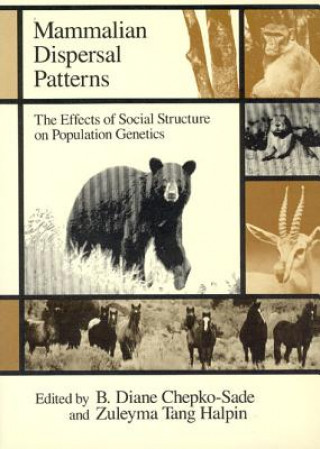
Książka Mammalian Dispersal Patterns B. Diane Chepko-Sade

Mammalian Dispersal Patterns

The Effects of Social Structure on Population Genetics

Język: Angielski
Oprawa: Miękka
Dostępność: Dostępna u dostawcy w małych ilościach
Wysyłamy za 13-18 dni
212.00
Mammalian Dispersal Patterns examines the ways that social structure affects population genetics and...
Informacje o książce

Język
Angielski
Oprawa
Książka - Miękka
Data wydania
1987
strony
352
EAN
9780226102689
Enbook ID
04543370
Waga
566
Wymiary
200 x 200 x 20

Pełny opis

Mammalian Dispersal Patterns examines the ways that social structure affects population genetics and, in turn, rates of evolution, in mammalian groups. It brings together fieldwork in animal behavior and wildlife biology with theoretical work in demography and population genetics. The focus here is dispersal--whether, how, and when individuals leave the areas where they are born. Theoretical work in population genetics indicates that such social factors as skewed sex ratios, restrictive mating patterns, and delayed age of first reproduction will lower the reproductive variability of a population by reducing the number of genotypes passed from one generation to the next. Field studies have shown that many mammalian species do exhibit many such social characteristics. Among horses, elephant seals, and a number of primates, the majority of females are inseminated by only a fraction of the males. In pacts of wolves and mongooses, usually only the highest-ranking male and female breed in a given season. Although socially restricted mating tends to lower genetic variability in isolated populations, it actually tends to increase genetic variability in subdivided populations with low rates of migration between subunits. Among some species there is little dispersal and thus little gene flow between subpopulations; other species travel far afield before mating. The contributors to this volume examine actual data from populations of mammals, the way patterns of dispersal correlate with the genetic structure of individuals and populations, and mathematical models of population structure. This interdisciplinary approach has an important bearing on work in conservation of both wildlife and zoo populations, for it shows that the home range and the population size needed to maintain genetic variability can differ greatly from one species to the next. The volume also offers a fruitful model for future research.

Możesz być zainteresowany

Dinosaur Art II

Steve White
131.48
175.18

Encyclopedia of Tango

Gabriel Valiente
139.83
427.16
896.16
89.84

Mammalian Paleoecology

Felisa A. Smith
367.16

1Q84: Book 3

Haruki Murakami
49.19

R.N.A.S. Operations Reports

Naval Staff Operations Division
194.23

Learning and Development Handbook

Michelle Parry–slater
189.91

Ana Ros

Kaja Sajovic
184.90
150.83

Klienci, którzy kupili tę książkę, kupili również

31.32
37.50

IL FISCHIO DEL VAPORE

DE GREGORI_ MARINI
130.60

Krvni izdajnik

Lynette Noni
81.10
25.52
19.34
31.91

Nostradamus

Zevaco Michel
69.02
107.81

Marina

Carlos Ruiz Zafón
51.05