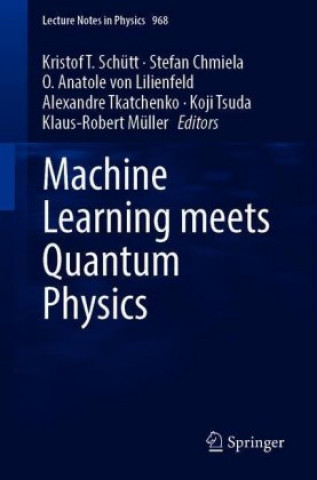
Książka Machine Learning Meets Quantum Physics Kristof T. Schütt

Machine Learning Meets Quantum Physics

Język: Angielski
Oprawa: Miękka
Dostępność: Dostępna u dostawcy
Wysyłamy za 5-8 dni
380.80
Designing molecules and materials with desired properties is an important prerequisite for advancing...

Informacje o książce

Język
Angielski
Oprawa
Książka - Miękka
Data wydania
2020
strony
467
EAN
9783030402440
Enbook ID
25391839
Waga
735
Wymiary
155 x 235 x 27

Pełny opis

Designing molecules and materials with desired properties is an important prerequisite for advancing technology in our modern societies. This requires both the ability to calculate accurate microscopic properties, such as energies, forces and electrostatic multipoles of specific configurations, as well as efficient sampling of potential energy surfaces to obtain corresponding macroscopic properties. Tools that can provide this are accurate first-principles calculations rooted in quantum mechanics, and statistical mechanics, respectively. Unfortunately, they come at a high computational cost that prohibits calculations for large systems and long time-scales, thus presenting a severe bottleneck both for searching the vast chemical compound space and the stupendously many dynamical configurations that a molecule can assume. To overcome this challenge, recently there have been increased efforts to accelerate quantum simulations with machine learning (ML). This emerging interdisciplinary community encompasses chemists, material scientists, physicists, mathematicians and computer scientists, joining forces to contribute to the exciting hot topic of progressing machine learning and AI for molecules and materials. The book that has emerged from a series of workshops provides a snapshot of this rapidly developing field. It contains tutorial material explaining the relevant foundations needed in chemistry, physics as well as machine learning to give an easy starting point for interested readers. In addition, a number of research papers defining the current state-of-the-art are included. The book has five parts (Fundamentals, Incorporating Prior Knowledge, Deep Learning of Atomistic Representations, Atomistic Simulations and Discovery and Design), each prefaced by editorial commentary that puts the respective parts into a broader scientific context.

Możesz być zainteresowany

49.57

Gears

Vincenzo Vullo
549.29
48.02

Ryder

Ali Parker
53.65

Life Without Limits

Chrissie Wellington
76.99
350.08
75.53

Meant to Be Mine

Hannah Orenstein
55.80

Organizational Design

RICHARD M. BURTON
193.46

Code of Capital

Katharina Pistor
102.36

Juncture 2020

Jennifer Engel
64.16
230.79

Klienci, którzy kupili tę książkę, kupili również

262.49
343.96
537.42
293.69
73.68
39.36
39.85
32.56
46.46

The Love Hypothesis

Ali Hazelwood
29.64

El fenómeno Sartre

Norbert Bilbeny
85.16

Coses nostres

RAMON MADAULA
67.66
38.20
102.85