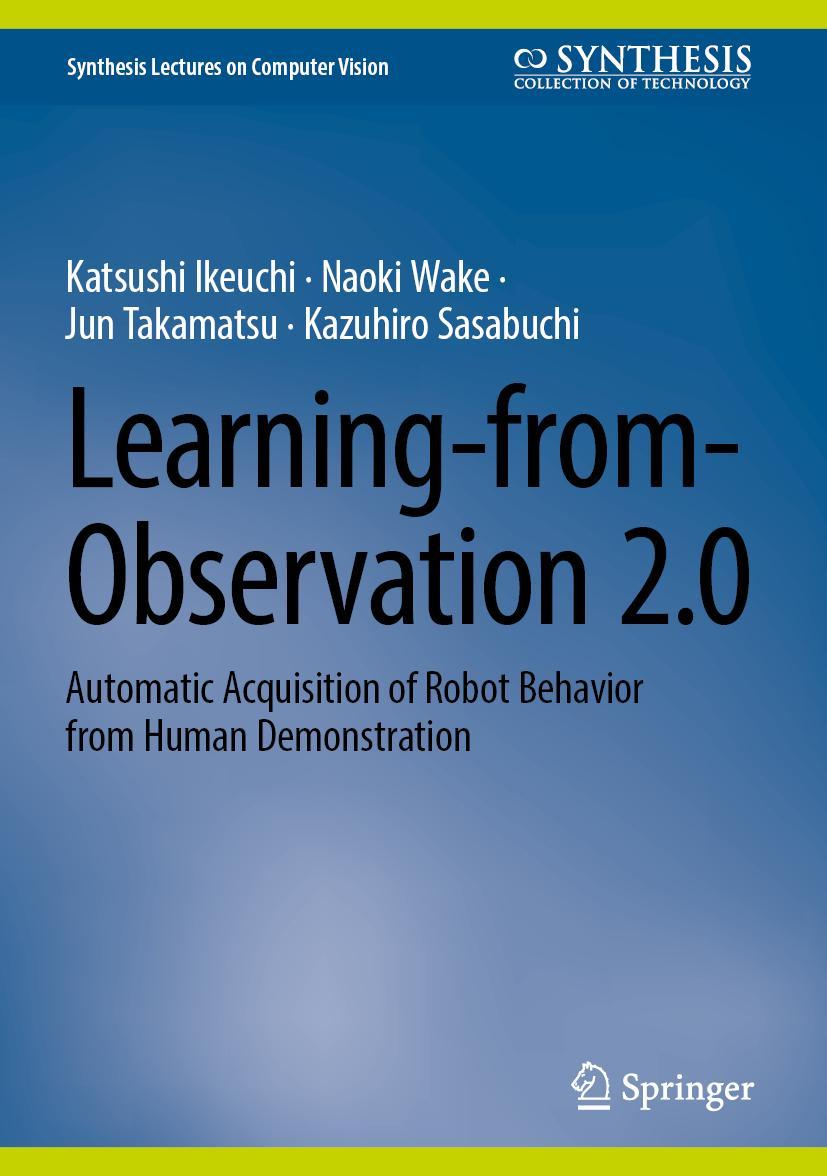
Książka Learning-from-Observation 2.0 Naoki Wake

Learning-from-Observation 2.0

Język: Angielski
Oprawa: Twarda
Dostępność: Dostępna u dostawcy
Wysyłamy za 10-13 dni
167.84
This book presents recent breakthroughs in the field of Learning-from-Observation (LfO) resulting fr...
Informacje o książce

Język
Angielski
Oprawa
Książka - Twarda
Data wydania
2025
strony
140
EAN
9783032034441
ISBN
3032034442
Enbook ID
49241541
Waga
596

Pełny opis

This book presents recent breakthroughs in the field of Learning-from-Observation (LfO) resulting from advancement in large language models (LLM) and reinforcement learning (RL) and positions it in the context of historical developments in the area. LfO involves observing human behaviors and generating robot actions that mimic these behaviors. While LfO may appear similar, on the surface, to Imitation Learning (IL) in the machine learning community and Programing-by-Demonstration (PbD) in the robotics community, a significant difference lies in the fact that these methods directly imitate human hand movements, whereas LfO encodes human behaviors into the abstract representations and then maps these representations onto the currently available hardware (individual body) of the robot, thus indirectly mimicking them. This indirect imitation allows for absorbing changes in the surrounding environment and differences in robot hardware. Additionally, by passing through this abstract representation, filtering can occur, distinguishing between important and less important aspects of human behavior, enabling imitation with fewer demonstrations and less demanding demonstrations. The authors have been researching the LfO paradigm for the past decade or so.  Previously, the focus was primarily on designing necessary and sufficient task representations to define specific task domains such as assembly of machine parts, knot-tying, and human dance movements. Recent advancements in Generative Pre-trained Transformers (GPT) and RL have led to groundbreaking developments in methods to obtain and map these abstract representations. By utilizing GPT, the authors can automatically generate abstract representations from videos, and by employing RL-trained agent libraries, implementing robot actions becomes more feasible.

Możesz być zainteresowany

616.99

Attakapas Country, The

Harry Lewis Griffin
117.56
66.97
61.57
187.39
521.33
231.98
209.29
95.95
48.80
35.45

From Moses to Malachi

KENNETH G. HANNA
111.96

My Favorite Things

Norma Isobella Burdon
80.04

Love's Lure

Professor John Ford
46.94

Learning From Las Vegas

Izenour Venturi Robert
106.26

Klienci, którzy kupili tę książkę, kupili również