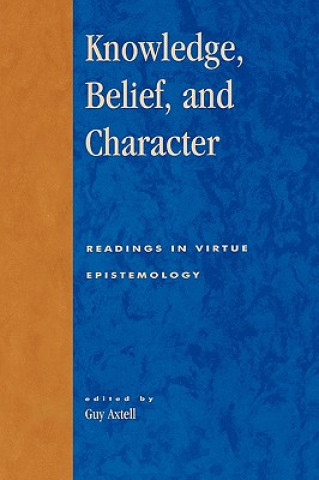
Książka Knowledge, Belief, and Character G. Axtell

Knowledge, Belief, and Character

Readings in Contemporary Virtue Epistemology

Język: Angielski
Oprawa: Miękka
Dostępność: Dostępna u dostawcy
Wysyłamy za 10-18 dni
191.69
There have been many books over the past decade, including outstanding collections of essays, on the...


Informacje o książce

Język
Angielski
Oprawa
Książka - Miękka
Data wydania
2000
strony
256
EAN
9780847696536
ISBN
0847696537
Enbook ID
04943897
Waga
394
Wymiary
228 x 153 x 20

Pełny opis

There have been many books over the past decade, including outstanding collections of essays, on the topic of the ethical virtues and virtue-theoretic approaches in ethics. But the professional journals of philosophy have only recently seen a strong and growing interest in the intellectual virtues and in the development of virtue-theoretic approaches in epistemology. There have been four single-authored book length treatments of issues of virtue epistemology over the last seven years, beginning with Ernest Sosa's Knowledge in Perspective (Cambridge, 1991), and extending to Linda Zabzebski's Virtue of the Mind (Cambridge, 1996). Weighing in with Jonathan Kvanvig's The Intellectual Virtues and the Life of the Mind (1992), and James Montmarquet's Epistemic Virtue and Doxastic Responsibility (1993), Rowman & Littlefield has had a particularly strong interest in the direction and growth of the field. To date, there has been no collection of articles directly devoted to the growing debate over the possibility and potential of a virtue epistemology. This volume exists in the belief that there is now a timely opportunity to gather together the best contributions of the influential authors working in this growing area of epistemological research, and to create a collection of essays as a useful course text and research source. Several of the articles included in the volume are previously unpublished. Several essays discuss the range and general approach of virtue theory in comparison with other general accounts. What advantages are supposed to accrue from a virtue-based account in epistemology, in handling well-known problems such as "Gettier," and "Evil-Genie"-type problems? Can reliabilist virtue epistemology handle skeptical challenges more satisfactorily than non-virtue-centered forms of epistemic reliabilism? Others provide a needed discussion of relevant analogies and disanalogies between ethical and epistemic evaluation. The readings all contribute

Możesz być zainteresowany

480.81
85.41

Prophet

Kahlil Gibran
18.88

Klienci, którzy kupili tę książkę, kupili również