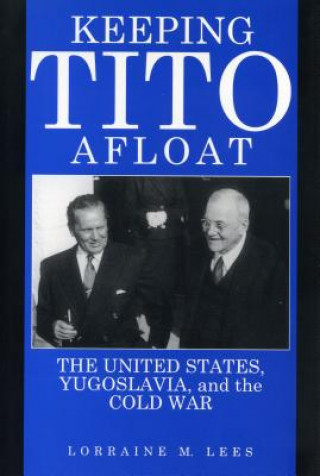
Książka Keeping Tito Afloat Lorraine M. Lees

Keeping Tito Afloat

Język: Angielski
Oprawa: Miękka
Dostępność: Dostępna u dostawcy
Wysyłamy za 9-15 dni
197.17
""Keeping Tito Afloat offers the most comprehensive treatment of U.S.-Yugoslav relations during the...


Informacje o książce

Język
Angielski
Oprawa
Książka - Miękka
Data wydania
1997
strony
268
EAN
9780271026503
ISBN
0271026502
Enbook ID
04563970
Waga
408
Wymiary
229 x 154 x 24

Pełny opis

""Keeping Tito Afloat offers the most comprehensive treatment of U.S.-Yugoslav relations during the Cold War. Lees has an excellent feel for the development of policy within the American government, and she provides insightful analysis of the motives and actions of key people in the Truman and Eisenhower administrations. But the book is not simply focused on the U.S.; it offers valuable insight into Tito and his ability to resist American 'plans' for him.""-Wilson D. Miscamble, University of Notre Dame ""This account is the best single source on United States-Yugoslav relations during the Truman and Eisenhower years.""-Journal of American History Keeping Tito Afloat draws upon newly declassified documents to show the critical role that Yugoslavia played in U.S. foreign policy with the communist world in the early years of the Cold War. After World War II, the United States considered Yugoslavia to be a loyal Soviet satellite, but Tito surprised the West in 1948 by breaking with Stalin. Seizing this opportunity, the Truman administration sought to ""keep Tito afloat"" by giving him military and economic aid. President Truman hoped that American involvement would encourage other satellites to follow Tito's example and further damage Soviet power. However, Lees demonstrates that it was President Eisenhower and Secretary of State John Foster Dulles who most actively tried to use Tito as a ""wedge"" to liberate the Eastern Europeans. By the end of 1958, Eisenhower and Dulles discontinued this ""wedge strategy"" because it raised too many questions about the ties that should exist between communist, non-communist, and neutral states. As Tito shrewdly kept the U.S. at arm's length, Eisenhower was forced to accept Tito's continued absence from the Soviet orbit as victory enough. In the period between 1958 and 1960, Lees examines U.S. political objectives that remained after military support for Tito was discontinued. Although use of Yugoslavia as a wedge never fully succ

Możesz być zainteresowany

Ussher Memoirs

William Betham
146.64
859.90

Red Flag Wounded

Ronald Suny
111.29

Smiles

Ginger Auel
87.04

Treasure Island

Robert Louis Stevenson
77.01

Home

Nicholas D Cassady
53.74
42.35

Queen of Blood

Sarah Beth Durst
33.00

Luzerne County

Harrison Wick
85.78

Blue Book of Nebo

Manon Steffan Ros
44.49
1 257.87

Savage

Tracy Lorraine
64.94

Prometheus Assessed?

Kiyoshi Yamamoto
337.20

Jericho

Dirk Bogarde
75.45

Doing Fieldwork

Rosalie H. Wax
315.09
37.77

Hayden White

Herman Paul
117.23
548.30

Klienci, którzy kupili tę książkę, kupili również

132.03
97.85

Lo último que verán tus ojos

Isabel San Sebastián
53.55

O Plebiscito de 1993

Pomerancblum Tenente Lays
153.94

One Piece 19

Eiichiro Oda
28.52

Billy Bat. Bd.2

Naoki Urasawa
45.07

ZMĚNIT SÁM SEBE

Vojtěch Hladký
36.90