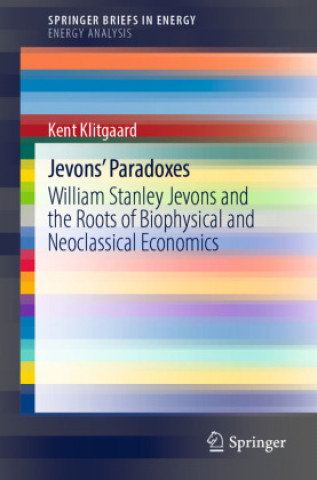
Książka Jevons' Paradoxes Kent Klitgaard

Jevons' Paradoxes

William Stanley Jevons and the Roots of Biophysical and Neoclassical Economics

Język: Angielski
Oprawa: Miękka
Dostępność: Dostępna u dostawcy
Wysyłamy za 5-8 dni
213.92
In 1865, economist William Stanley Jevons published The Coal Question, describing the crucial role t...


Informacje o książce

Język
Angielski
Oprawa
Książka - Miękka
Data wydania
2022
strony
120
EAN
9783030935887
Enbook ID
38504564
Waga
226
Wymiary
155 x 235 x 8

Pełny opis

In 1865, economist William Stanley Jevons published The Coal Question, describing the crucial role that coal played in British economic development. Here, he enunciated what has come to be known as the Jevons paradox, which stated that improvements in resource efficiency leads to greater resource use as the expansion of scale occasioned by lower operating costs overwhelms the savings due to greater efficiency. The implications for any sustainability scenario are enormous and a major theme of this book. While The Coal Question provided the theory that was a precursor to peak oil and resource limits to growth, it was followed six years later by the Theory of Political Economy, the first English-language work of neoclassical economics, which denies the importance of energy as a special commodity. In spite of this apparent contradiction, in this book biophysical economist Kent Klitgaard makes clear that there is no epistemological break between The Coal Question and Theory of Political Economy. Indeed, the Jevons paradox makes little sense in the absence of a behavioral theory grounded in marginal utility, which recognizes the satisfaction that each of us gains as consumers of one more unit of a good or service. Jevons could not solve this paradox in light of his belief that coal mines were becoming exhausted and more expensive to operate, and that there was no substitute for coal. However, he was uninterested in questions of sustainability; rather, he wanted to maintain British industrial and imperial dominance. Did the eventual substitution of oil for coal simply allow us to run through other resources at an accelerated rate? Indeed, the petroleum economy of the 20th and early 21st centuries has presented vastly expanded opportunities for the operation of the Jevons Paradox. This book shows the connections among the different paradoxes in Jevons' work, and exposes the potentially fatal flaws that confound technological solutions to the sustainability challenge.

Możesz być zainteresowany

58.13

Blaming the Victim

Rateau Jackson Rateau
47.05
46.56
685.22
865.82

Creative Imagination

June E. Downey
1 491.14

Klienci, którzy kupili tę książkę, kupili również

114.60
69.60

Rögtön jövök

Csordás Dániel
50.48

Fantastische Wolven

Thiago Soares
82.45