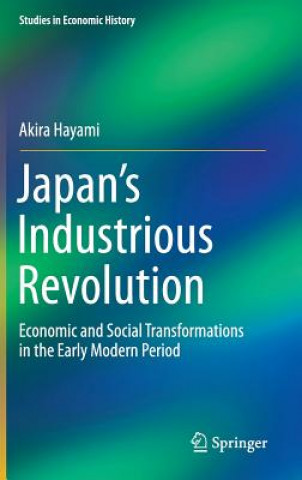
Książka Japan's Industrious Revolution Akira Hayami

Japan's Industrious Revolution

Economic and Social Transformations in the Early Modern Period

Autor: Akira Hayami
Język: Angielski
Oprawa: Twarda
Dostępność: Dostępna u dostawcy
Wysyłamy za 10-13 dni
216.67
This book explains in fascinating detail how the fruits of the Industrious Revolution are what have...


Informacje o książce

Autor
Język
Angielski
Oprawa
Książka - Twarda
Data wydania
2015
strony
130
EAN
9784431551416
ISBN
4431551417
Enbook ID
07175758
Waga
3554
Wymiary
155 x 235 x 243

Pełny opis

This book explains in fascinating detail how the fruits of the Industrious Revolution are what have supported Japan since the eighteenth century, improving living standards and leading to the formation of the work ethic of modern Japan.§§The arrival of the Sengoku Period in the sixteenth century saw the emergence and domination of government by the warrior class. It was Tokugawa Ieyasu who unified the realm. Yet this unity did not give rise to an autocratic state, as the shogun was recognized merely as a main pillar of the warrior class.§§Economically, however, from the fourteenth century, currency payments for sh en nengu (taxes paid to the proprietor) became standard, and currency circulation began, primarily in the central region. Under Tokugawa rule, organized domestic coinage of currency began, opening the way to establishing a national economic society. Also, agricultural land was surveyed through cadastral surveys known as kenchi . Land values were converted in terms of rice, so the expected rice yields for each village were assessed, and the lords used this as a benchmark for imposing taxes.§§In the sixteenth and seventeenth centuries, Japan experienced a great transition, and conditions for peasants, agriculture, and farming villages underwent great changes. Inefficient traditional agriculture using peasants in a state of servitude was transformed into highly efficient small-sized farming operations which relied on family labor. As production yields increased due to labor-intensive agriculture, the profits obtained by the peasants improved their living standards. The stem-family system became the norm through which work ethics and even literacy were transmitted. This very change was the result of the industrious revolution in Japan.§§The book thus presents the framework of the facts of pre-industrial Japanese history and depicts pre-modern Japan from a macroscopic point of view, showing how the industrious revolution came about. It is certain to be of great interest to economists and historians alike.§

Możesz być zainteresowany

Nightlights

Lorena Alvarez
38.52
33.75

Joys of Love

Madeleine L'Engle
50.73

Lucy Kemp-Welch 1869-1958

Dr David Boyd Haycock
194.43
249.05

Gentle Discipline

Sarah Ockwell-Smith
63.05

Nuggets for the Golden Years

Gordon Van Rooy Ph D
80.92

History of The Brissotins

Camille Desmoulins
124.82
96.91

Fairy Tale

Stephen King
104.66

Tarot Original 1909 Kit

Arthur Edward Waite
115.48
40.90
67.22

Klienci, którzy kupili tę książkę, kupili również

Darn Bach o'r Haul

Gwasg y Bwthyn
54.61
126.01
161.86

Schriften zur Bildung

Wilhelm von Humboldt
33.66
80.92
198.10