Use the following as plain text. It contains no HTML, code, hidden characters, review claims, price language, urgency devices, or unsupported superlatives.
Internal medicine becomes more manageable when facts are organized around the decisions that matter at the bedside.
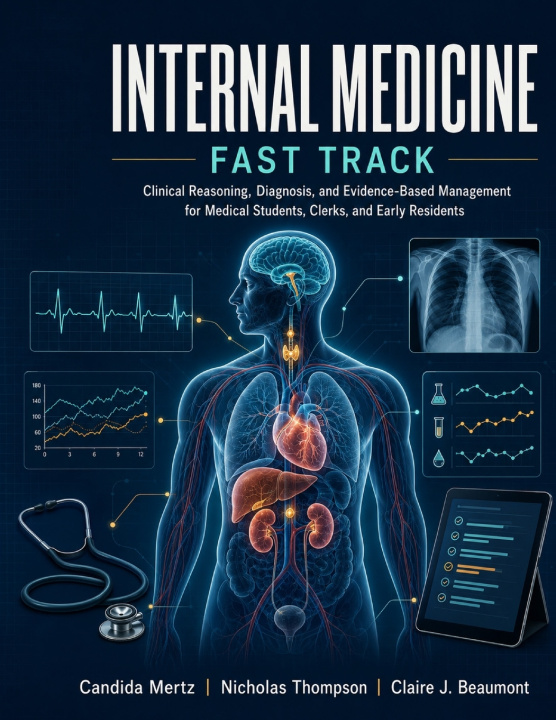
Internal Medicine Fast Track is a case-oriented learning resource for medical students, clinical clerks, and early residents who want to connect foundational knowledge with practical clinical reasoning. Rather than treating symptoms, test results, and treatments as isolated facts, the book follows the path from the patient's presentation to a prioritized differential diagnosis, focused evaluation, initial management, reassessment, and follow-up.
Across twenty chapters, the text examines foundations of clinical reasoning; cardiovascular, respiratory, gastrointestinal, renal, endocrine, hematologic, oncologic, infectious, rheumatologic, neurologic, geriatric, dermatologic, allergic, psychiatric, acute, critical, preventive, sex- and gender-aware, perioperative, diagnostic, and pharmacologic topics. Capstone cases bring multiple conditions together and reinforce the need to balance urgency, uncertainty, comorbidity, medication safety, and patient goals.
Learning objectives establish a clear purpose for each chapter. Clinical cases place knowledge in context. Comparison tables organize important distinctions. Review questions support retrieval practice, while explanations and selected references encourage deeper study. Throughout the book, attention is given to red flags, diagnostic calibration, safe transitions of care, communication, monitoring, and the limits of algorithms.
Inside you will explore how to:
- Build concise problem representations from histories, examinations, and initial data
- Prioritize dangerous and likely diagnoses without losing important alternatives
- Choose and interpret common diagnostic tests in clinical context
- Connect initial treatment with medication safety, monitoring, and reassessment
- Recognize presentations that require urgent escalation or specialist involvement
- Integrate multimorbidity, frailty, prevention, perioperative risk, and patient goals
- Apply clinical reasoning through cases, review questions, and cross-system scenarios
Use Internal Medicine Fast Track as a substantial companion for coursework, clinical rotations, supervised case discussion, and ongoing review. Because recommendations and drug information change, all clinical decisions should be checked against current authoritative guidance, local protocols, and qualified supervision.