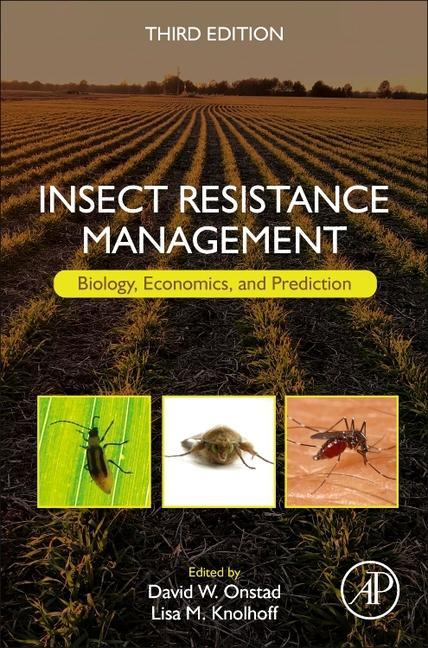
Insect Resistance Management: Biology, Economics, and Prediction, Third Edition offers a foundational basis for understanding pest biology, a necessity for working with pest management and resistance management. For years, entomologists have understood that, with their use of economic thresholds, a minimal use of economics is necessary for proper integrated pest management (IPM); meanwhile, insect resistance management, or IRM, is even more complicated and dependent on the understanding and use of socioeconomic factors. This latest edition of Insect Resistance Management addresses these issues and much more.This book includes a new chapter focusing on resistance mechanisms related to plant-incorporated toxins and heavily expanded revisions of several existing chapters. Authors in this edition include professors at major universities, leaders in the chemical and seed industry, evolutionary biologists and active IRM practitioners. This revision also contains more information about IRM outside North America, and a modeling chapter contains a large new section on uncertainty analysis, a subject recently emphasized by the U.S. Environmental Protection Agency. The final chapter contains a section on insecticidal seed treatments.Insect Resistance Management: Biology, Economics, and Prediction, Third Edition is an invaluable resource for researchers and practitioners in entomology and IRM work particularly. Graduate students in entomology courses, as well as applied ecology and agricultural economics researchers, may also find this latest edition useful and relevant. Provides insights from the history of insect resistance management (IRM) to the latest science Includes contributions from experts on ecological aspects of IRM, molecular and population genetics, economics, and IRM social issues Offers biochemistry and molecular genetics of insecticides presented with an emphasis on recent research Encourages scientists and stakeholders to implement and coordinate strategies based on local social conditions