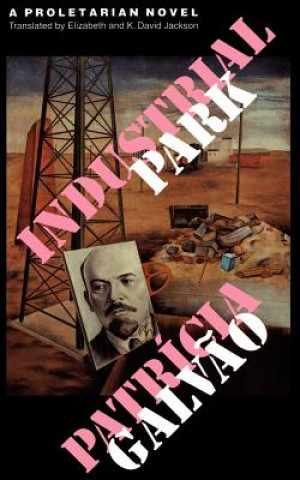
Książka Industrial Park Patricia Galvao

Industrial Park

Język: Angielski
Oprawa: Miękka
Dostępność: Dostępna u dostawcy
Wysyłamy za 14-21 dni
96.36
"A forceful and sensitive translation, the story follows the struggles of three female workers in Sa...


Informacje o książce

Język
Angielski
Oprawa
Książka - Miękka
Data wydania
1993
strony
154
EAN
9780803270411
ISBN
0803270410
Enbook ID
04924024
Waga
198
Wymiary
140 x 216 x 15

Pełny opis

"A forceful and sensitive translation, the story follows the struggles of three female workers in Sao Paulo...Through it all these strong women survive in a world where sharing popcorn with a lover is ultimately more real than all the talk of triumph of the proletariat."--Publishers Weekly A member of Brazil's avant-garde in its heyday. Patricia Galvao (or to use her nickname, Pagu) was extraordinary. Not only was her work among the most exciting and innovative published in the 1930s, it was unique in portraying an avant-garde woman's view of women in Sao Paulo during that audacious period. Industrial Park, first published in 1933, is Galvao's most notable literary achieve-ment. Like Doblin's portrayal of Berlin in Alexanderplatz or Biely's St Petersburg, it is a book about the voices, clashes, and traffic of a city in the middle of rapid change. It includes fragments of public documents as well as dialogue and narration, giving a panorama of the city in a sequence of colorful slices. The novel dramatizes the problems of exploitation, poverty, racial prejudice, prostitution, state repression, and neocolonialism, but it is by no means a doctrinaire tract. Galvao's ironic wit pervades the novel, aspiring not only to describe the teeming city but also to put art and politics in each other's service. Like many of her contemporaries Galvao was a member of the Brazilian Communist Party. She attracted Party criticism for her unorthodox behavior and outspokenness. A visit to Moscow in 1934 disenchanted her with the communist state, but she continued to militate for change upon returning to Brazil. She was imprisoned and tortured under the Vargas dictatorship between 1935 and 1940. In the 1940s she returned to the public through her journalism and literary activities. She died in 1962. K. David Jackson is a professor of Portuguese language and literature at Yale University. Elizabeth Jackson coordinates a middle school curriculum project on Brazil for the Institute of Latin American Studies at the University of Texas at Austin.

Możesz być zainteresowany

Partytrap

Steven McCallum
168.93

Where the Night Reigns

Emilie Lucadamo
50.45

Political Elections

Davis Worth Miller
107.91

Positive Journey

Drummond Marais
136.35

Pancreatic Cancer

Lisa M Strahs-Lorenc
96.46
76.71
139.41

The Fellowship of the Ring

John Ronald Reuel Tolkien
38.10

From New York to San Francisco

Ernst Mendelssohn-Bartholdy
143.86
102.58
99.82

Indian Philosophy

Jeffery D. Long
117.20

Rites of Realism

Ivone Margulies
179.40
65.85

I Am You

Karl F. Morrison
228.67

Klienci, którzy kupili tę książkę, kupili również

Puissance éternelle

Miss Sandra Dumeix
54.49

Die Verlobten

Professor Alessandro Manzoni
92.91
130.33

LA ASISTENTA

FREIDA MCFADDEN
82.24
92.51