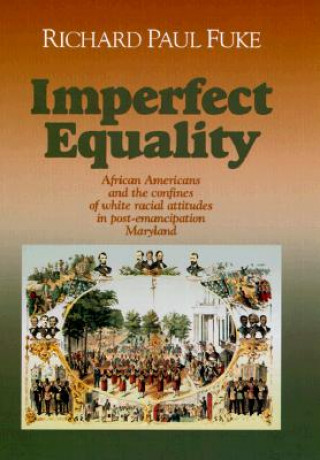
In Imperfect Equality, Richard Fuke has explores the immediate aftermath of slavery in Maryland, which differed in important ways from the slaveholding states of the South: it never left the Union; white radicals had a period of access to power; and even prior to legal emancipation, a large free black population resided there. Moreover, the presence of Baltimore, a major city and port, provided abundant evidence with which to compare the rural and the urban experience of black Marylanders. This state study is therefore uniquely revealing of the successes and failures of the post-emancipation period. The transition in Maryland from a slave to a free society, Fuke argues, presented to black Marylanders opportunities to achieve previously inaccessible goals. Blacks were able to realize some goals, such as greater land ownership, control over the labor of their children, education, and the formation of independent cultural and social organizations, through their own intrepidity combined with the support of white radicals as well as with the assistance of the Freedmen's Bureau, the United States Army, and some state-controlled agencies.
Other goals-such as social equality, economic opportunity and advancement, and suffrage-remained beyond the reach of blacks, not only because of conservative white opposition, but also, Fuke argues, because of the attitudinal limitations of white radicals unable to confront the full range of post-emancipation possibilities. Calling upon a very broad range of sources, Fuke demonstrates that after emancipation, Black Marylanders neither enjoyed total freedom nor suffered absolute coercion, but their struggle made two things clear: much of whatever they might accomplish, they would have to do by themselves; and such efforts would remain confined by white attitudes determined to regulate them.